Event submissions
Published
This submission belongs to the session Session 1. General Organic Synthesis of the event The 30th International Electronic Conference on Synthetic Organic Chemistry
Published date
02 Nov, 2026
Academic Editor
 Julio A. Seijas
Citation
Frederick Dauda, Asmau Kassim, Idris Abdullahi, Salim Aminu, A COMPUTATIONAL APPROACH FOR THE DESIGN AND SYNTHESIS OF SOME THIAZOLIDINE-2,4-DIONE DERIVATIVES AS POTENTIAL ANTIDIABETIC AGENTS TARGETING PEROXISOME PROLIFERATOR-ACTIVATED RECEPTOR GAMMA (PPARγ), in Proceedings of The 30th International Electronic Conference on Synthetic Organic Chemistry, 5 November–19 November 2026, MDPI: Basel, Switzerland
Share
Email
Facebook
Twitter
LinkedIn
A COMPUTATIONAL APPROACH FOR THE DESIGN AND SYNTHESIS OF SOME THIAZOLIDINE-2,4-DIONE DERIVATIVES AS POTENTIAL ANTIDIABETIC AGENTS TARGETING PEROXISOME PROLIFERATOR-ACTIVATED RECEPTOR GAMMA (PPARγ)

Frederick Dauda 1
Asmau Kassim 1
Idris Abdullahi 1

Salim Aminu 1
1. Department of Pharmaceutical and Medicinal Chemistry, Faculty of Pharmaceutical Sciences, Kaduna State University, Kaduna 800283, Nigeria
Abstract
Abstract
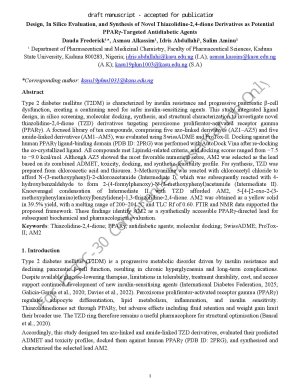
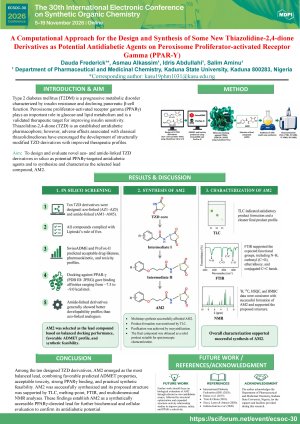
Type 2 diabetes mellitus (T2DM) remains a major metabolic disorder driven by insulin resistance and progressive pancreatic β-cell dysfunction, necessitating the development of safer and more effective insulin-sensitizing agents. This study aimed to design, synthesize, and characterize novel thiazolidine-2,4-dione (TZD) derivatives as potential antidiabetic agents targeting peroxisome proliferator-activated receptor gamma (PPARγ).
A focused library of ten TZD derivatives, comprising five azo-linked (AZ1–AZ5) and five amide-linked (AM1–AM5) analogues, was designed and evaluated in-silico for drug-likeness, pharmacokinetic properties, and predicted toxicity using SwissADME and ProTox-II. Molecular docking against the human PPARγ ligand-binding domain (PDB ID: 2PRG) was performed using AutoDock Vina following validation by re-docking the co-crystallized ligand. Based on integrated ADMET, toxicity, and docking performance, AM2 was selected as the lead compound for experimental synthesis.
AM2 was successfully synthesized via a multistep synthetic route involving formation of the TZD core, sequential intermediate generation, and final Knoevenagel condensation. The synthesized compound was monitored by thin-layer chromatography and structurally confirmed using Fourier-transform infrared and nuclear magnetic resonance spectroscopy.
All designed compounds complied with Lipinski’s rule of five, with the amide-linked series demonstrating superior predicted developability. Docking affinities ranged from −7.5 to −9.0 kcal/mol, indicating favourable interaction within the PPARγ binding pocket. The successful synthesis and characterization of AM2 validate the computational predictions.
These findings demonstrate that rationally designed and experimentally validated TZD derivatives, particularly AM2, represent promising PPARγ-directed lead compounds for further biological evaluation.
Keywords
Thiazolidine-2,4-dione
PPAR-γ
Molecular docking
Swiss ADME
ProTox-II
Antidiabetic agents
Computer-aided drug design
Drug Synthesis
Computational chemistry.
Manuscript
[Sciforum-201233] - [Manuscript PDF] - [Submission accepted].pdf
Poster
[Sciforum-201233] - [Poster] - [Submission accepted].pdf
Flow Chemistry in the Synthesis of a Model API with Organometallic Reagents: Thermodynamic Efficiency and Process Safety within the Framework of “Green Chemistry”
Synthesis of Helical Carbazoles Incorporating an Imidazole Ring