Event submissions
Published
This submission belongs to the session Session 1. General Organic Synthesis of the event The 30th International Electronic Conference on Synthetic Organic Chemistry
Published date
02 Nov, 2026
Academic Editor
 Julio A. Seijas
Citation
Salim Aminu, Rabiu Bako, Idris Abdullahi, Frederick Dauda, Design, Synthesis, and Evaluation of Phenylhydrazone Derivatives as Potential Antibacterial Agents, in Proceedings of The 30th International Electronic Conference on Synthetic Organic Chemistry, 5 November–19 November 2026, MDPI: Basel, Switzerland
Share
Email
Facebook
Twitter
LinkedIn
Design, Synthesis, and Evaluation of Phenylhydrazone Derivatives as Potential Antibacterial Agents

Salim Aminu 1

Rabiu Bako 1

Idris Abdullahi 1
Frederick Dauda 1
1. Department of pharmaceutical and Medicinal Chemistry, Kaduna State University, Kaduna State 800283, Nigeria
Abstract
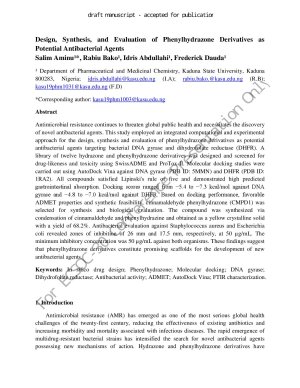
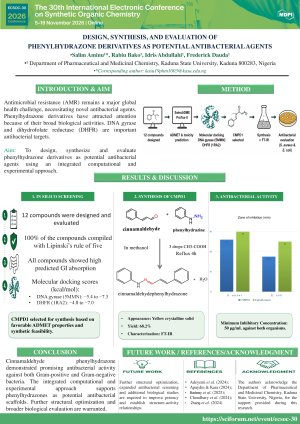
Antimicrobial resistance continues to pose a significant global health threat, creating an urgent need for novel antibacterial agents. This study aimed to design, synthesize, and evaluate phenylhydrazone derivatives as potential inhibitors of bacterial DNA gyrase and dihydrofolate reductase (DHFR). Twelve benzaldehyde-based hydrazone and phenylhydrazone derivatives were designed and screened for drug-likeness, pharmacokinetic properties, and toxicity using SwissADME and Protox III. Molecular docking studies were performed using AutoDock Vina against DNA gyrase (PDB: 5MMN) and DHFR (PDB: 1RA2). The compounds demonstrated favorable binding affinities ranging from −5.4 to −7.3 kcal/mol for DNA gyrase and −4.8 to −7.0 kcal/mol for DHFR.
Based on docking performance, ADMET characteristics, and synthetic feasibility, cinnamaldehyde phenylhydrazone was selected for synthesis. The compound was synthesized through a condensation reaction between cinnamaldehyde and phenylhydrazine under reflux conditions and characterized by Fourier Transform Infrared (FT-IR) spectroscopy. The synthesized product was obtained as a yellow crystalline solid with a yield of 68.2%.
Antibacterial activity was evaluated against Staphylococcus aureus and Escherichia coli using the agar well diffusion method. The compound exhibited zones of inhibition of 26 mm and 17.5 mm against S. aureus and E. coli, respectively, at 50 µg/mL. The minimum inhibitory concentration (MIC) was 50 µg/mL against both organisms. These findings suggest that phenylhydrazone derivatives represent promising scaffolds for the development of novel antibacterial agents.
Keywords
In silico drug design
Phenylhydrazone derivatives
Antibacterial agents
Molecular docking
DNA gyrase
Dihydrofolate reductase (DHFR)
ADMET prediction
AutoDock Vina
Organic synthesis
FTIR characterization
Manuscript
[Sciforum-201874] - [Manuscript PDF] - [Submission accepted].pdf
Poster
[Sciforum-201874] - [Poster] - [Submission accepted].pdf
Synthesis of imidazo[2,1-b]thiazoles via GBB reaction
Green Synthesis of Oximes Using Low-Melting Sugar Mixtures