Event submissions
Published
This submission belongs to the session Session 2. Chemistry of Bioorganics, Medicinal and Natural Products of the event The 30th International Electronic Conference on Synthetic Organic Chemistry
Published date
02 Nov, 2026
Academic Editor
 Julio A. Seijas
Citation
Polina Yakovets, High-Throughput Virtual Screening of Xanthene Derivatives Against a Range of Model and Real Insect Protein Structures for Developing Molecular Tools or Prototypes of New Insect Control Agents
, in Proceedings of The 30th International Electronic Conference on Synthetic Organic Chemistry, 5 November–19 November 2026, MDPI: Basel, Switzerland
Share
Email
Facebook
Twitter
LinkedIn
High-Throughput Virtual Screening of Xanthene Derivatives Against a Range of Model and Real Insect Protein Structures for Developing Molecular Tools or Prototypes of New Insect Control Agents

Polina Yakovets 1,2
1. Faculty of Chemistry, Belarusian State University, Minsk, 220030, Belarus
2. Sector of Fine Organic Synthesis, Research Institute for Physical Chemical Problems, Belarusian State University, Minsk, 220006, Belarus
Abstract
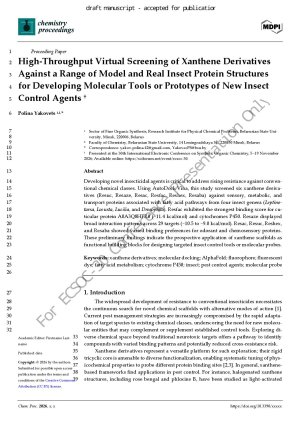
To identify potential scaffolds for ecologically responsible pest control, six xanthene derivatives—Resuc (3-(6-hydroxy-3-oxo-3H-xanthen-9-yl)propanoic acid), Resaze (8-(6-hydroxy-3-oxo-3H-xanthen-9-yl)octanoic acid), Resac (6-hydroxy-9-methyl-3H-xanthen-3-one), Resfac (6-hydroxy-9-(trifluoromethyl)-3H-xanthen-3-one), Reshex (6-hydroxy-9-pentyl-3H-xanthen-3-one), Resaba (9-(3-aminopropyl)-6-hydroxy-3H-xanthen-3-one)—were screened using AutoDock Vina against sensory, fatty acid metabolism, reception, and transport proteins (UniProt or PDB IDs) from Leptinotarsa, Locusta, Lucilia, and Drosophila species to evaluate binding affinities (Ebind, kcal/mol).
Resfac demonstrated the highest affinity for cuticular protein A0A3Q8HFR0 (-11.4), various odorant receptors (-10.7 to -9.7), and cytochromes P450 (CYP12d1, CYP307a1, CYP4G29, CYP314a1; -10.6 to -9.6). Resac bound odorant receptors (-10.7 to -9.4; e.g., I6LU05: -10.7) and chemosensory proteins Q3LB86 (-10.7 to -10.2). Resaze displayed the highest polyspecificity, interacting with 29 targets (-10.5 to -9.0), notably cuticular protein A0A3Q8HFR0 (-10.5) and chemosensory proteins (-9.9 to -9.5). Resuc bound cuticular protein A0A3Q8HFR0 (-10.6), several odorant receptors (-10.0 to -8.8), and cytochromes P450 (e.g., CYP6a2: -9.4). Reshex interacted with cuticular protein A0A3Q8HFR0 (-9.9) and chemosensory protein Q869F2 (-9.9). Resaba bound to cuticular protein A0A3Q8HFR0 (-10.1) and odorant receptor I6LU03 (-10.3).
These profiles demonstrate the varied interaction of these xanthene scaffolds, suggesting their prospective application in the design of insect control agents or molecular probes.
Supported by BRFFR No. 20261794 and Ministry of Education grant No. 20261474.
Keywords
Xanthene derivatives
Molecular docking
AlphaFold
Fluorophore
Fluorescent dye
Fatty acid metabolism
Cytochrome P450
Insects
Pest control
Molecular probe
Manuscript
[Sciforum-202480] - [Manuscript PDF] - [Submission accepted].pdf
Transamination reaction of 3-[(dimethylamino)methylidene]- 5-arylfuran-2(3H)-thiones with the participation of 2-amino-4-methylphenol
Green Microwave-Assisted Synthesis of β-Chloroacrylonitriles for the Development of Novel Sulfur- and Nitrogen-Containing Heterocyclic Derivatives