Event submissions
Published
This submission belongs to the session Session 1. General Organic Synthesis of the event The 30th International Electronic Conference on Synthetic Organic Chemistry
Published date
02 Nov, 2026
Academic Editor
 Anna Pratima Nikalje
Citation
CHELLALI Ferial, Datoussaid Yazid, Cherigui Samir, Hassaine ridha, Attar Tarik, Seijas vàzquez Julio Antonio, Vázquez-Tato María Pilar, Green Microwave-Assisted Synthesis of β-Chloroacrylonitriles for the Development of Novel Sulfur- and Nitrogen-Containing Heterocyclic Derivatives, in Proceedings of The 30th International Electronic Conference on Synthetic Organic Chemistry, 5 November–19 November 2026, MDPI: Basel, Switzerland
Share
Email
Facebook
Twitter
LinkedIn
Green Microwave-Assisted Synthesis of β-Chloroacrylonitriles for the Development of Novel Sulfur- and Nitrogen-Containing Heterocyclic Derivatives

CHELLALI Ferial 1
Datoussaid Yazid 1
Cherigui Samir 2
Hassaine ridha 3
Attar Tarik 4

Seijas vàzquez Julio Antonio 5

Vázquez-Tato María Pilar 5
1. Laboratory of catalysis and synthesis in organic chemistry, Faculty of sciences, University of Tlemcen, BP119, Tlemcen 13000, Algeria.
2. Department of Chemistry, Faculty of Exact Sciences, University of Béjaïa, Béjaïa 06000, Algeria
3. Scientific and Technical Research Center for Physico-Chemical Analyses (CRAPC), Bou Ismaïl, Tipaza, Algeria
4. Laboratory of toxicomed, Unoversity of Tlemcen, BP 119, Tlemcen 13000, Algeria
5. Departamento de QuímicaOrgánica, Facultade de Ciencias, Universidade de Santiago de Compostela, lugo-Spain
Abstract
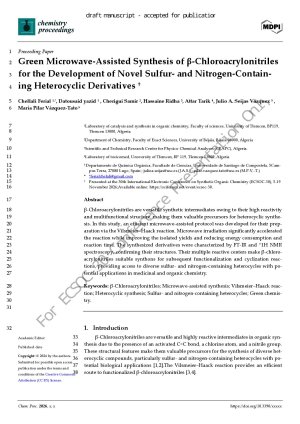
β-Chloroacrylonitriles constitute an important class of highly functionalized synthetic intermediates in organic chemistry due to the simultaneous presence of an activated carbon–carbon double bond, a chlorine atom, and a nitrile group. These complementary reactive functionalities confer exceptional synthetic versatility, making β-chloroacrylonitriles attractive precursors for the preparation of a broad range of biologically relevant heterocyclic compounds. In the present study, an efficient and sustainable microwave-assisted synthetic protocol was developed for the preparation of β-chloroacrylonitrile derivatives via the Vilsmeier–Haack reaction. The application of microwave irradiation ensured rapid and uniform energy transfer throughout the reaction medium, considerably accelerating the reaction process while enhancing the isolated yields of the desired products. This approach also simplified the experimental procedure, reduced energy consumption, and minimized reaction times, making it consistent with the principles of green chemistry. The synthesized β-chloroacrylonitrile derivatives were successfully characterized by FT-IR and 1H NMR spectroscopy, confirming the formation and structural integrity of the target molecules. Owing to their unique electronic properties and the presence of multiple reactive centers, these compounds represent versatile synthons for subsequent functionalization and cyclization reactions. They provide convenient access to structurally diverse sulfur- and nitrogen-containing heterocyclic scaffolds, which are widely recognized for their promising pharmaceutical and biological activities. Consequently, the developed microwave-assisted methodology offers a rapid, efficient, and environmentally friendly route for the synthesis of β-chloroacrylonitriles, providing valuable intermediates for the design and preparation of novel sulfur- and nitrogen-containing heterocyclic derivatives with potential applications in medicinal chemistry and advanced organic synthesis.
Keywords
β-Chloroacrylonitriles
Microwave-assisted synthesis
Vilsmeier–Haack reaction
Heterocyclic synthesis
Sulfur- and nitrogen-containing heterocycles
Green chemistry.
Manuscript
[Sciforum-202015] - [Manuscript PDF] - [Submission accepted].pdf
High-Throughput Virtual Screening of Xanthene Derivatives Against a Range of Model and Real Insect Protein Structures for Developing Molecular Tools or Prototypes of New Insect Control Agents
Sonochemical synthesis of alkyne-functionalized 1,5-disubstituted tetrazoles via Ugi-azide reaction