Event submissions
Published
This submission belongs to the session Session 2. Chemistry of Bioorganics, Medicinal and Natural Products of the event The 30th International Electronic Conference on Synthetic Organic Chemistry
Published date
02 Nov, 2026
Academic Editor
 Julio A. Seijas
Citation
Vikesh Kumar, Nandish B.T., Sowmya Rao, Synthesis, Characterization and Oxidative Stability of Long-Chain Tertiary Amino Alcohols for ROS-Responsive Chitosan Hydrogel Applications, in Proceedings of The 30th International Electronic Conference on Synthetic Organic Chemistry, 5 November–19 November 2026, MDPI: Basel, Switzerland
Share
Email
Facebook
Twitter
LinkedIn
Synthesis, Characterization and Oxidative Stability of Long-Chain Tertiary Amino Alcohols for ROS-Responsive Chitosan Hydrogel Applications

Vikesh Kumar 1
Nandish B.T. 1
Sowmya Rao 1
1. Department of Dental Materials, Yenepoya Dental College, Yenepoya (Deemed to be University), Mangalore – 575018, Karnataka, India
Abstract
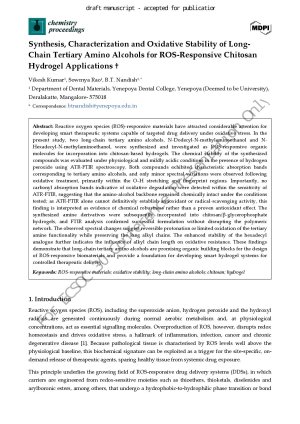
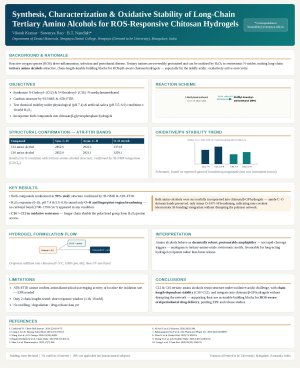
Reactive oxygen species (ROS)-responsive materials have attracted considerable attention for developing smart therapeutic systems capable of targeted drug delivery under oxidative stress. In the present study, two long-chain tertiary amino alcohols, N-Dodecyl-N-methylaminoethanol and N-hexadecyl-N-methylaminoethanol, were synthesized and investigated as ROS-responsive organic molecules for incorporation into chitosan-based hydrogels. The chemical stability of the synthesized compounds was evaluated under physiological and mildly acidic conditions in the presence of hydrogen peroxide using ATR-FTIR spectroscopy. Both compounds exhibited characteristic absorption bands corresponding to tertiary amino alcohols, and only minor spectral variations were observed following oxidative treatment, primarily within the O–H stretching and fingerprint regions. Importantly, no carbonyl absorption bands indicative of oxidative degradation was detected, demonstrating excellent structural stability under ROS-rich conditions. The synthesized amine derivatives were subsequently incorporated into chitosan/β-glycerophosphate hydrogels, and FTIR analysis confirmed successful formulation without disrupting the polymeric network. The observed spectral changes suggest reversible protonation or limited oxidation of the tertiary amine functionality while preserving the long alkyl chains. The enhanced stability of the hexadecyl analogue further indicates the influence of alkyl chain length on oxidative resistance. These findings demonstrate that long-chain tertiary amino alcohols are promising organic building blocks for the design of ROS-responsive biomaterials and provide a foundation for developing smart hydrogel systems for controlled therapeutic delivery.
Keywords
ROS-responsive materials
Oxidative stability
Long chain aminoalcohols
Chitosan
hydrogel.
Manuscript
[Sciforum-202680] - [Manuscript PDF] - [Submission accepted].pdf
Poster
[Sciforum-202680] - [Poster] - [Submission accepted].pdf
Selective Synthesis of ω-Hydroxyalkoxy Derivatives of Binor-S with the Use of a Binary Catalytic System FeCl3 – TsOH*H2O
Drug Repurposing Study to Identify pan-Flaviviral NS2B/NS3 Protease Inhibitors