Event submissions
Published
This submission belongs to the session Session 1. General Organic Synthesis of the event The 30th International Electronic Conference on Synthetic Organic Chemistry
Published date
02 Nov, 2026
Academic Editor
 Julio A. Seijas
Citation
Vikas Patil, Rahul Patil, Lina Jadhav, Satish V Patil, Sharad Patil, Bhavana V Mohite, Bio-Based Eugenol-Derived Azo Pigments: Synthesis, Characterization, and Corrosion Protection Performance in Epoxy Coatings, in Proceedings of The 30th International Electronic Conference on Synthetic Organic Chemistry, 5 November–19 November 2026, MDPI: Basel, Switzerland
Share
Email
Facebook
Twitter
LinkedIn
Bio-Based Eugenol-Derived Azo Pigments: Synthesis, Characterization, and Corrosion Protection Performance in Epoxy Coatings

Vikas Patil 1
Rahul Patil 2
Lina Jadhav 3
Satish V Patil 4
Sharad Patil 5
Bhavana V Mohite 6
1. University Institute of Chemical Technology, Kavayitri Bahinabai Chaudhari North Maharashtra University, Jalgaon, India
2. Y.C.S.P. Mandal’s Dadasaheb Digambar Shankar Patil Arts, Commerce and Science College, Erandol, Jalgaon, 425109, India
3. School of Chemical Sciences, Kavayitri Bahinabai Chaudhari North Maharashtra University, Jalgaon, Maharashtra, 425001, India
4. School of Life Sciences, Kavayitri Bahinabai Chaudhari North Maharashtra University, Jalgaon, Maharashtra, 425001, India
5. Department of Chemistry, SPDM Art’s, SBB & SHD Commerce and SMA Science College Shirpur, 425405, India
6. Department of Microbiology, Bajaj College of Science, Wardha 442001, MH, India
Abstract
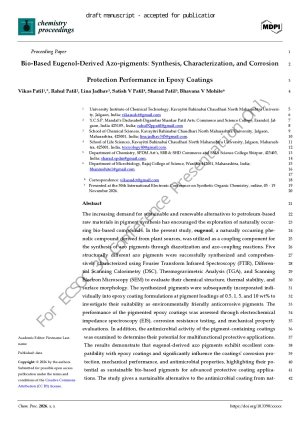
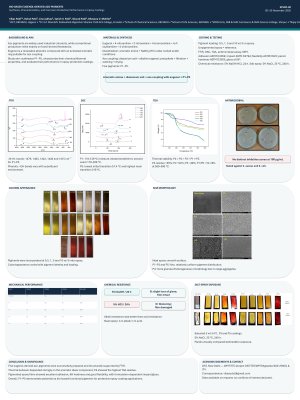
The increasing demand for sustainable and renewable alternatives to petroleum-based raw materials in pigment synthesis has encouraged the exploration of naturally occurring bio-based compounds. In the present study, eugenol, a naturally occurring phenolic compound derived from plant sources, was utilized as a coupling component for the synthesis of azo pigments through diazotization and azo-coupling reactions. Five structurally different azo pigments were successfully synthesized and comprehensively characterized using Fourier Transform Infrared Spectroscopy (FTIR), Differential Scanning Calorimetry (DSC), Thermogravimetric Analysis (TGA), and Scanning Electron Microscopy (SEM) to evaluate their chemical structure, thermal stability, and surface morphology. The synthesized pigments were subsequently incorporated individually into epoxy coating formulations at pigment loadings of 0.5, 1, 5, and 10 wt% to investigate their suitability as environmentally friendly anticorrosive pigments. The performance of the pigmented epoxy coatings was assessed through electrochemical impedance spectroscopy (EIS), corrosion resistance testing, and mechanical property evaluations. In addition, the antimicrobial activity of the pigment-containing coatings was examined to determine their potential for multifunctional protective applications. The results demonstrate that eugenol-derived azo pigments exhibit excellent compatibility with epoxy coatings and significantly influence the coatings' corrosion protection, mechanical performance, and antimicrobial properties, highlighting their potential as sustainable bio-based pigments for advanced protective coating applications. The study gives a sustanable alternative to the antimicrobial coating from naturally derived sources.
Keywords
Eugenol
Bio-based azo pigments
Epoxy coatings
Corrosion resistance
Antimicrobial coatings
Manuscript
[Sciforum-202098] - [Manuscript PDF] - [Submission accepted].pdf
Poster
[Sciforum-202098] - [Poster] - [Submission accepted].pdf
Forced Degradation Studies of Selected Marker Compounds Using Novel HPTLC Based Approach and Mass Spectrometric Characterization
Triterpenoid Dimerization as a Bioactivity-Modulating Strategy: From Natural Pristimerin Dimers to Semi-Synthetic Oleanolic Acid Derivatives