Event submissions
Published
This submission belongs to the session Session 2. Chemistry of Bioorganics, Medicinal and Natural Products of the event The 30th International Electronic Conference on Synthetic Organic Chemistry
Published date
02 Nov, 2026
Academic Editor
 Julio A. Seijas
Citation
Andrzej Günther, Triterpenoid Dimerization as a Bioactivity-Modulating Strategy: From Natural Pristimerin Dimers to Semi-Synthetic Oleanolic Acid Derivatives, in Proceedings of The 30th International Electronic Conference on Synthetic Organic Chemistry, 5 November–19 November 2026, MDPI: Basel, Switzerland
Share
Email
Facebook
Twitter
LinkedIn
Triterpenoid Dimerization as a Bioactivity-Modulating Strategy: From Natural Pristimerin Dimers to Semi-Synthetic Oleanolic Acid Derivatives

Andrzej Günther 1
1. Department of Organic Chemistry, Faculty of Pharmacy, Poznan University of Medical Sciences, Collegium Pharmaceuticum 2 (CP.2), ul. Rokietnicka 3, 60–806 Poznań, Poland
Abstract
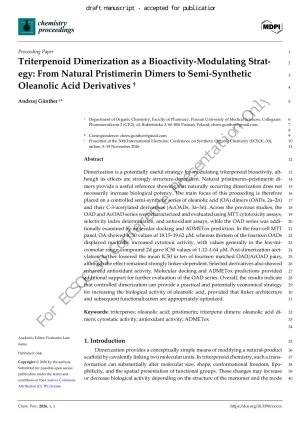
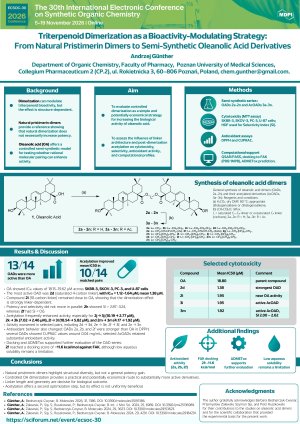
Introduction: Dimerization is an important but still underexploited strategy for modulating the biological potential of plant-derived triterpenoids. Natural pristimerin dimers illustrate the structural diversity of triterpenoid dimers, whereas semi-synthetic oleanolic acid dimers provide a convenient model for evaluating how controlled molecular pairing affects bioactivity.
Methods: This work combines a focused review of naturally occurring triterpenoid dimers with original experimental studies on oleanolic acid derivatives. Oleanolic acid dimers were obtained by linking two triterpenoid units through the C-17 carboxyl group using α,ω-dihalogenoalkanes or α,ω-dihalogenoalkenes, followed by acetylation of selected derivatives. The compounds were characterized by spectroscopic methods and evaluated using QSAR analysis, MTT cytotoxicity assays, selectivity index determination, DPPH and CUPRAC antioxidant assays, molecular docking and ADMETox prediction.
Results: The reviewed data indicate that natural triterpenoid dimerization does not always lead to stronger cytotoxic or antimicrobial activity, suggesting that the biological consequences of dimer formation are highly structure-dependent. In contrast, synthetic oleanolic acid dimers showed markedly improved cytotoxic/cytostatic activity compared with the parent compound in multiple cancer cell models. Several non-acetylated dimers displayed IC50 values below 10 μM, while acetylated analogues often showed even stronger activity, with IC50 values below 5 μM. Antioxidant activity was also enhanced in selected derivatives, and computational studies suggested favorable interactions with cancer-related targets and acceptable predicted ADMETox profiles.
Conclusions: Dimerization, especially when combined with rational linker design and post-dimerization acetylation, represents a promising strategy for transforming oleanolic acid into highly active triterpenoid-based derivatives.
Keywords
triterpenes
oleanolic acid
triterpene dimers
oleanolic acid dimers
cytostatic activity
antioxidant activity
ADMETox
Manuscript
[Sciforum-202744] - [Manuscript PDF] - [Submission accepted].pdf
Poster
[Sciforum-202744] - [Poster] - [Submission accepted].pdf
Bio-Based Eugenol-Derived Azo Pigments: Synthesis, Characterization, and Corrosion Protection Performance in Epoxy Coatings
Structure-based virtual screening of semisynthetic isocyanide-based multicomponent reactions for the identification of potencial AdeJ transporter inhibitors in Acinetobbacter baumanii