Event submissions
Published
This submission belongs to the session Session 2. Chemistry of Bioorganics, Medicinal and Natural Products of the event The 30th International Electronic Conference on Synthetic Organic Chemistry
Published date
02 Nov, 2026
Academic Editor
 Julio A. Seijas
Citation
Jose Antonio Vargas-Rodriguez, Abel Suarez-Castro, Structure-based virtual screening of semisynthetic isocyanide-based multicomponent reactions for the identification of potencial AdeJ transporter inhibitors in Acinetobbacter baumanii, in Proceedings of The 30th International Electronic Conference on Synthetic Organic Chemistry, 5 November–19 November 2026, MDPI: Basel, Switzerland
Share
Email
Facebook
Twitter
LinkedIn
Structure-based virtual screening of semisynthetic isocyanide-based multicomponent reactions for the identification of potencial AdeJ transporter inhibitors in Acinetobbacter baumanii

Jose Antonio Vargas-Rodriguez 1
Abel Suarez-Castro 2
1. Faculty of Medical and Biological Sciences "Dr. Ignacio Chavez", Universidad Michoacana de San Nicolas de Hidalgo, Morelia, Michoacan, Mexico
2. School of Medicine, Faculty of Health Sciences, Universidad Vasco de Quiroga, Morelia, Michoacan, Mexico.
Abstract
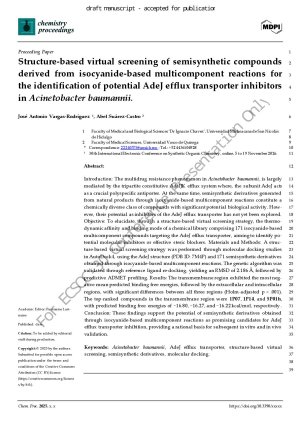
Introduction: The multidrug resistance phenomenon in Acinetobacter baumannii, is largely mediated by the tripartite constitutive AdeIJK efflux system where, the subunit AdeJ acts as a crucial polyspecific antiporter. At the same time, semisynthetic derivatives generated from natural products through isocyanide-based multicomponent reactions constitute a chemically diverse class of compounds with significant potential biological activity, however, their potential as inhibitors of the AdeJ efflux transporter has not yet been explored.
Objective: To elucidate, through a structure-based virtual screening strategy, the thermodynamic affinity and binding mode of a chemical library comprising 176 isocyanide-based multicomponent compounds targeted the AdeJ efflux transporter, aiming to identify potential molecular inhibitors or effective steric blockers.
Materials and Methods: A structure-based virtual screening strategy was performed through molecular docking studies in Autodock4, using the AdeJ structure (PDB ID: 7M4P) and 176 semisynthetic derivatives obtained through isocyanide-based multicomponent reactions. The genetic algorithm was validated through reference ligand re-docking, yielding an RMSD of 2.186 Å, followed by predictive ADMET profiling.
Results: Virtual screening showed two semisynthetic desmycosin derivatives and one semisynthetic β-amyrin derivative emerged as the most promising candidates, exhibiting binding free energies of −16.80, −16.27, and −16.22 kcal/mol, respectively establishing hydrogen bonds and aromatic π-π stacking interactions with critical residues. In silico analysis corroborated strict compliance with Veber druggability rules, suggesting pharmacological viability.
Conclusion: These findings support the potential of semisynthetic derivatives obtained through isocyanide-based multicomponent reactions as promising candidates for AdeJ efflux transporter inhibition, providing a rational basis for subsequent in vitro and in vivo validation.
Keywords
Acinetobacter baumannii
AdeJ efflux transporter
structure-based virtual screening
semisynthetic derivatives
molecular docking.
Manuscript
[Sciforum-202788] - [Manuscript PDF] - [Submission accepted].pdf
Triterpenoid Dimerization as a Bioactivity-Modulating Strategy: From Natural Pristimerin Dimers to Semi-Synthetic Oleanolic Acid Derivatives
Solvent-Free O-Propylation of Phenol and Cresol Isomers Catalyzed by Cu(acac)2 with Polyhalomethane Promoters