Event submissions
Published
This submission belongs to the session Session 2. Chemistry of Bioorganics, Medicinal and Natural Products of the event The 30th International Electronic Conference on Synthetic Organic Chemistry
Published date
02 Nov, 2026
Academic Editor
 Julio A. Seijas
Citation
Luis Alberto Prieto Ramírez, Nora Khiar Fernández, Victoria Valdivia, Rafael León, Claire Levoir, Rocío Recio, Inmaculada Fernández, Beyond Nrf2 Potency: Oxidation-State-Guided Stability and Drug-Likeness Profiling of N-Glycosyl Iberin Analogues, in Proceedings of The 30th International Electronic Conference on Synthetic Organic Chemistry, 5 November–19 November 2026, MDPI: Basel, Switzerland
Share
Email
Facebook
Twitter
LinkedIn
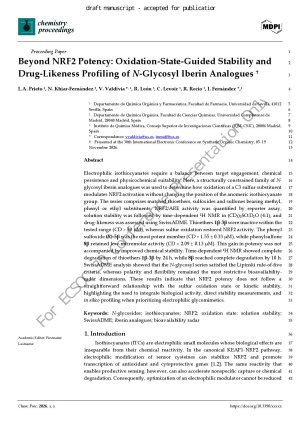
Beyond Nrf2 Potency: Oxidation-State-Guided Stability and Drug-Likeness Profiling of N-Glycosyl Iberin Analogues

Luis Alberto Prieto Ramírez 1
Nora Khiar Fernández 2
Victoria Valdivia 1

Rafael León 3
Claire Levoir 1
Rocío Recio 1
Inmaculada Fernández 1
1. Departamento de Química Orgánica y Farmacéutica, Facultad de Farmacia, Universidad de Sevilla, 41012 Sevilla, Spain
2. Department of Organic Chemistry, School of Chemistry, Universidad Complutense de Madrid, Madrid, Spain
3. Instituto de Química Médica, Consejo Superior de Investigaciones Científicas (IQM-CSIC), 28006 Madrid, Spain
Abstract
Introduction
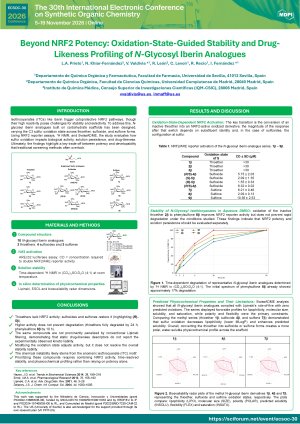
N-glycosyl isothiocyanates bearing sulfur-containing substituents at C3 constitute a well-defined family of carbohydrate-based iberin analogues. In this scaffold, the electrophilic N=C=S group is located at the anomeric position, while the sulfur substituent can be modulated through a thioether–sulfoxide–sulfone redox sequence. This provides a useful framework to examine how sulfur oxidation influences chemical stability and predicted drug-like behavior beyond Nrf2 potency.
Methods
A structurally matched set of N-glycosyl iberin analogues was comparatively profiled according to the oxidation state of the C3 sulfur substituent. Nrf2 activation was used as the biological reference parameter. Stability was assessed by time-dependent 1H NMR experiments in a DMSO-d₆/D₂O mixture, monitoring diagnostic resonances over time. Predicted ADME and drug-likeness descriptors were calculated using SwissADME, including bioavailability radar plots to compare polarity, lipophilicity, solubility, flexibility and size.
Results
Sulfur oxidation had a marked impact on biological and developability profile of the series. Thioether derivatives showed negligible Nrf2 modulation, whereas the corresponding sulfoxides and sulfones displayed low-micromolar activity, with phenyl-substituted oxidized analogues giving the most favorable responses. However, 1H NMR monitoring showed that the isothiocyanate group at the anomeric position reduces chemical robustness in DMSO-d₆/D₂O medium. SwissADME radar plots revealed oxidation-dependent changes in polarity, lipophilicity, solubility, and global drug-likeness.
Conclusions
Sulfur oxidation state acts as a key activity-switching and developability-modulating element in N-glycosyl iberin analogues. Integrating Nrf2 activity, 1H NMR-monitored solution stability and SwissADME descriptors provide a rational basis for prioritizing carbohydrate-based electrophilic redox modulators.
Keywords
N-Glycosyl isothiocyanates
Redox modulation
Solution stability
ADME prediction
Nrf2 activators
Manuscript
[Sciforum-202800] - [Manuscript PDF] - [Submission accepted].pdf
Poster
[Sciforum-202800] - [Poster] - [Submission accepted].pdf
Virtual Screening of Hydrophobic Heterocyclic Compounds as Potential Insect Chitinase Inhibitors
Computer-Aided Discovery of Potential Acinetobacter baumannii AdeB Inhibitors through Structure-Based Virtual Screening