Event submissions
Published
This submission belongs to the session Session 2. Chemistry of Bioorganics, Medicinal and Natural Products of the event The 30th International Electronic Conference on Synthetic Organic Chemistry
Published date
02 Nov, 2026
Academic Editor
 Julio A. Seijas
Citation
David Martin De La Hoz-Insignares, Abel Suárez-Castro, Computer-Aided Discovery of Potential Acinetobacter baumannii AdeB Inhibitors through Structure-Based Virtual Screening, in Proceedings of The 30th International Electronic Conference on Synthetic Organic Chemistry, 5 November–19 November 2026, MDPI: Basel, Switzerland
Share
Email
Facebook
Twitter
LinkedIn
Computer-Aided Discovery of Potential Acinetobacter baumannii AdeB Inhibitors through Structure-Based Virtual Screening

David Martin De La Hoz-Insignares 1
Abel Suárez-Castro 2
1. Faculty of Pharmaceutical Sciences, Zaragocilla Campus – Health Sciences Area, University of Cartagena, Cartagena, Bolívar, Colombia.
2. School of Medicine, Faculty of Health Sciences, Universidad Vasco de Quiroga, Morelia, Michoacán, Mexico.
Abstract
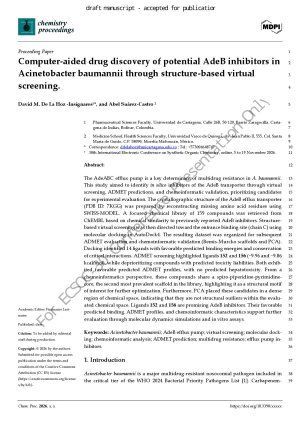
Introduction: Drug resistance in Acinetobacter baumannii is mediated by multiple mechanisms, including multidrug efflux pumps. Among these, the AdeABC resistance-nodulation-division efflux system is one of the principal determinants, with AdeB serving as the inner membrane transporter responsible for substrate recognition and the active extrusion of structurally diverse antibacterial agents.
Objective: To identify potential inhibitors of the AdeB efflux transporter through a computer-aided drug discovery strategy integrating structure-based virtual screening and molecular docking, thereby prioritizing candidates for subsequent QSAR analysis, molecular dynamics simulations, and experimental validation.
Materials and Methods: The crystallographic structure of the AdeB efflux transporter (PDB ID: 7KGG) was prepared by reconstructing missing amino acid residues using SWISS-MODEL. A focused library of 159 compounds was retrieved from ChEMBL based on chemical similarity to previously reported AdeB inhibitors, then, a structure-based virtual screening was directed toward different binding pockets using molecular docking in AutoDock4. The resulting dataset was organized for subsequent QSAR analysis and molecular dynamics simulations.
Results: Among the highest-ranked ligands, an imidazoline-based arylsulfonamide derivative exhibited the most favorable binding free energy of −10.25 kcal/mol, followed by a hydantoin derivative with −9.98 kcal/mol, and a diaryl diamide derivative with −9.46 kcal/mol. All three ligands were predicted to bind within the distal drug-binding pocket of AdeB, a region recognized as the primary binding site for most experimentally characterized AdeB inhibitors.
Conclusion: These findings enabled the prioritization of chemically diverse ligands targeting the AdeB distal drug-binding pocket, providing a computational framework for subsequent QSAR analysis, molecular dynamics simulations, and experimental validation.
Keywords
Acinetobacter baumannii
AdeB efflux transporter
computer-aided drug discovery
distal drug-binding pocket
multidrug resistance.
Manuscript
[Sciforum-202862] - [Manuscript PDF] - [Submission accepted].pdf
Beyond Nrf2 Potency: Oxidation-State-Guided Stability and Drug-Likeness Profiling of N-Glycosyl Iberin Analogues
Formation of β-Cyclodextrin Inclusion Complexes with Aloysia citrodora Essential Oil Collected from Western Algeria: Preparation and Characterization