Event submissions
Published
This submission belongs to the session Session 2. Chemistry of Bioorganics, Medicinal and Natural Products of the event The 30th International Electronic Conference on Synthetic Organic Chemistry
Published date
02 Nov, 2026
Academic Editor
 Julio A. Seijas
Citation
Kaddour Faiza, Abbad Sarra, Keniche Assia, Hassaine Ridha, Formation of β-Cyclodextrin Inclusion Complexes with Aloysia citrodora Essential Oil Collected from Western Algeria: Preparation and Characterization, in Proceedings of The 30th International Electronic Conference on Synthetic Organic Chemistry, 5 November–19 November 2026, MDPI: Basel, Switzerland
Share
Email
Facebook
Twitter
LinkedIn
Formation of β-Cyclodextrin Inclusion Complexes with Aloysia citrodora Essential Oil Collected from Western Algeria: Preparation and Characterization

Kaddour Faiza 1,2
Abbad Sarra 2
Keniche Assia 1
Hassaine Ridha 3,4
1. Laboratory of Organic Chemistry, Natural Substances and Analysis (COSNA), Department of Chemistry, 6 Tlemcen University, Tlemcen 13000, Algeria
2. Department of pharmacy, faculty of medicine, Tlemcen university, Tlemcen 13000, Algeria
3. Scientific and Technical Research Center for Physico-Chemical Analyses (CRAPC), Bou-Ismail, BP 384, 42004 11 Tipaza, Algeria
4. Laboratory of Catalysis and Organic Chemistry Synthesis, Faculty of Sciences, University of Tlemcen, BP 13 119, 13000 Tlemcen, Algeria
Abstract
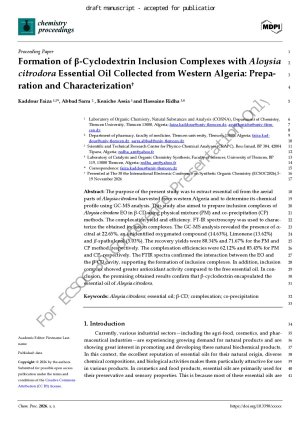
Essential oils are widely used in various industrial sectors because they contain bioactive compounds that possess a wide range of biological activities. They are used in the food industry to provide sensory and preservative effects. However, their applications are limited by their volatility, low water solubility, and instability. Microencapsulation using cyclodextrins (CD) is considered one of the possible approaches to overcoming these obstacles.
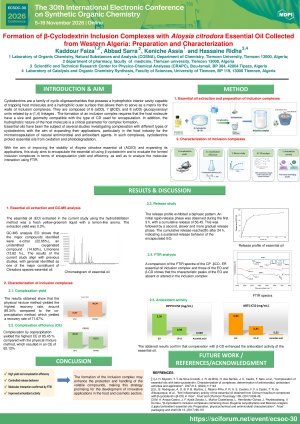
The purpose of the present study was to extract essential oil from the aerial parts of Aloysia citrodora harvested from western Algeria and determine its chemical profile using GC-MS analysis. This study also aimed to prepare inclusion complexes of Aloysia citrodora EO in β-CD using physical mixture (PM) and co-precipitation (CP) methods. The recovery of the inclusion complexes and entrapment efficiency were determined. FT-IR spectroscopy was used to characterize the obtained inclusion complexes.
The GC-MS analysis revealed the presence of geranial at 22.65% followed by 3,4-pentadienal 14.63%, Limonene 13.62 % and 𝛽-spathulenol 5.03%. The recovery percentage of the obtained powder was 80% and 70% for the PM and CP method ,respectively. The entrapment efficiencies were 62% and 85% for PM and CP, respectively. The FTIR spectra confirmed the interaction between the EO and the B-CD cavity.
The promising obtained results confirm that β-cyclodextrin encapsulated the essential oil of Aloysia citrodora. In order to optimize and evaluate the formulation in terms of stability and biological efficacy, further studies will be necessary.
Keywords
Aloysia citrodora
essential oil
β-cyclodextrin
Inclusion complexes
co-precipitation
Manuscript
[Sciforum-202864] - [Manuscript PDF] - [Submission accepted].pdf
Poster
[Sciforum-202864] - [Poster] - [Submission accepted].pdf
Computer-Aided Discovery of Potential Acinetobacter baumannii AdeB Inhibitors through Structure-Based Virtual Screening
ISOLATION, STRUCTURAL ELUCIDATION AND INSILICO ANTICANCER PROFILLING OF KAEMPFEROL GLYCOSIDES DERIVETIVES FROM NEPETA CATARIA TARGETING PI3Kα, mTOR, and AKT IN BREAST CANCER