Event submissions
Published
This submission belongs to the session Session 2. Chemistry of Bioorganics, Medicinal and Natural Products of the event The 30th International Electronic Conference on Synthetic Organic Chemistry
Published date
02 Nov, 2026
Academic Editor
 Julio A. Seijas
Citation
Imene DERARDJA, Redouane REBAI, Integrated systems pharmacology reveals the multitarget therapeutic mechanisms of pancratistatin against cholangiocarcinoma, in Proceedings of The 30th International Electronic Conference on Synthetic Organic Chemistry, 5 November–19 November 2026, MDPI: Basel, Switzerland
Share
Email
Facebook
Twitter
LinkedIn
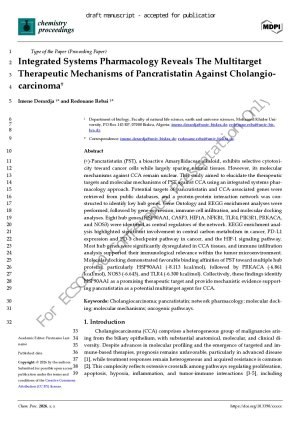
Integrated systems pharmacology reveals the multitarget therapeutic mechanisms of pancratistatin against cholangiocarcinoma

Imene DERARDJA 1
Redouane REBAI 1
1. Department of biology, Faculty of natural life science, earth and universe sciences, Mohamed Khider University, PO Box 145 RP, 07000 Biskra, Algeria
Abstract
Cholangiocarcinoma (CCA) is a highly aggressive biliary tract malignancy with poor prognosis and limited therapeutic options. Pancratistatin, a bioactive Amaryllidaceae alkaloid, exhibits selective cytotoxicity toward cancer cells while largely sparing normal tissues. However, its molecular mechanisms against CCA remain unclear. This study aimed to elucidate the therapeutic targets and molecular mechanisms of pancratistatin against CCA using an integrated systems pharmacology approach. Potential targets of pancratistatin and CCA-associated genes were retrieved from public databases, and a protein-protein interaction network was constructed to identify key hub genes using five cytoHubba algorithms. Gene Ontology and Kyoto Encyclopedia of Genes and Genomes enrichment analyses were performed, followed by gene expression, immune cell infiltration, and molecular docking analyses. Nine hub genes (HSP90AA1, CASP3, HIF1A, NFKB1, TLR4, PIK3R1, PRKACA, CDK1, and NOS2) were identified as central regulators of the therapeutic network. KEGG enrichment analysis highlighted significant involvement in the HIF-1 signaling pathway, PD-L1 expression and PD-1 checkpoint pathway in cancer, and central carbon metabolism in cancer. Most hub genes were significantly dysregulated in CCA tissues, and immune infiltration analysis supported their immunological relevance within the tumor microenvironment. Molecular docking demonstrated favorable binding affinities of pancratistatin toward multiple hub proteins, particularly HSP90AA1 (-8.11 kcal/mol), followed by PRKACA (-6.86 kcal/mol) and TLR4 (-6.30 kcal/mol). Collectively, these findings identify HSP90AA1 as a promising therapeutic target and provide mechanistic evidence supporting pancratistatin as a potential multitarget agent for cholangiocarcinoma.
Keywords
Cholangiocarcinoma
Pancratistatin
network pharmacology
molecular docking
molecular mechanisms
oncogenic pathways.
Manuscript
[Sciforum-202905] - [Manuscript PDF] - [Submission accepted].pdf
Phytochemical Analysis and In Vitro Antioxidant Evaluation of Portulaca oleracea L. Redjila Extracts
Efficient synthesis of novel α-aminophosphonates as potential anticancer agents. Molecular docking and DFT/ADMET analyses