Event submissions
Published
This submission belongs to the session Session 2. Chemistry of Bioorganics, Medicinal and Natural Products of the event The 30th International Electronic Conference on Synthetic Organic Chemistry
Published date
02 Nov, 2026
Academic Editor
 Julio A. Seijas
Citation
MALIKA BERREDJEM, Firdaws Belhadj, Seif-Eddine Djouad, Efficient synthesis of novel α-aminophosphonates as potential anticancer agents. Molecular docking and DFT/ADMET analyses, in Proceedings of The 30th International Electronic Conference on Synthetic Organic Chemistry, 5 November–19 November 2026, MDPI: Basel, Switzerland
Share
Email
Facebook
Twitter
LinkedIn
Efficient synthesis of novel α-aminophosphonates as potential anticancer agents. Molecular docking and DFT/ADMET analyses

MALIKA BERREDJEM 1
Firdaws Belhadj 1
Seif-Eddine Djouad 2
1. Laboratory of Applied Organic Chemistry, Synthesis of Biomolecules and Molecular Modelling Group, Department of Chemistry, Sciences Faculty, Badji Mokhtar Annaba University, Box 12, 23000 Annaba, Algeria
2. Laboratory of Therapeutic Chemistry, Faculty of Medicine, University of Batna 2, Batna, Algeria
Abstract
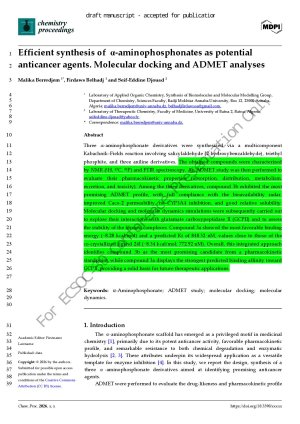
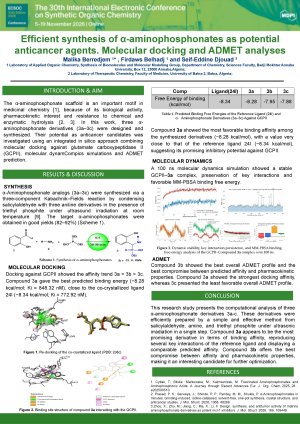
The α-aminophosphonate scaffold has emerged as a privileged motif in medicinal chemistry, primarily due to its potent anticancer activity, favorable pharmacokinetic profile, and remarkable resistance to both chemical degradation and enzymatic hydrolysis. These attributes underpin its widespread application as a versatile template for enzyme inhibition. In this study, we report the design, synthesis of a novel α-aminophosphonate derivatives aimed at identifying promising anticancer agents.
Density functional theory (DFT) calculations were performed to derive key thermodynamic parameters and physicochemical descriptors, providing insights into the electronic structure and intrinsic reactivity of the derivatives. Subsequently, molecular docking studies were conducted against glutamate carboxypeptidase II (GCP2), a validated cancer-related target, to predict the binding modes and estimate ligand–protein interaction affinities. The docking results identified derivatives with favorable binding energies and critical hydrogen-bonding networks within the active site.
To further validate these interactions, a 200-nanosecond molecular dynamics simulation was carried out under in silico physiological conditions. This extended simulation allowed for a rigorous assessment of the dynamic stability and conformational integrity of the protein–ligand complexes. The MD trajectories revealed that the representative α-aminophosphonate derivative maintained a stable binding conformation throughout the simulation, characterized by persistent key contacts and minimal root-mean-square deviation (RMSD) fluctuations. Collectively, our integrated synthetic, biological, and computational findings underscore the therapeutic potential of these novel α-aminophosphonates as stable, high-affinity inhibitors of GCP2, warranting further preclinical development.
Keywords
a-Aminophosphonate
DFT/ADMET properties
molecular docking
molecular dynamics.
Manuscript
[Sciforum-202908] - [Manuscript PDF] - [Submission accepted].pdf
Poster
[Sciforum-202908] - [Poster] - [Submission accepted].pdf
Integrated systems pharmacology reveals the multitarget therapeutic mechanisms of pancratistatin against cholangiocarcinoma
Apigenin as a Natural Flavonoid Modulator of Estrogen Receptor Alpha: An Integrated Molecular Docking and Molecular Dynamics Study