Event submissions
Published
This submission belongs to the session Session 2. Chemistry of Bioorganics, Medicinal and Natural Products of the event The 30th International Electronic Conference on Synthetic Organic Chemistry
Published date
02 Nov, 2026
Academic Editor
 Julio A. Seijas
Citation
Aouiffat Yacine, Safia Derbali, BAKCHICHE Boulanouar, Farouk BENACEUR, Imededdine Kadi, BENMEDDOUR Tarek, Apigenin as a Natural Flavonoid Modulator of Estrogen Receptor Alpha: An Integrated Molecular Docking and Molecular Dynamics Study, in Proceedings of The 30th International Electronic Conference on Synthetic Organic Chemistry, 5 November–19 November 2026, MDPI: Basel, Switzerland
Share
Email
Facebook
Twitter
LinkedIn
Apigenin as a Natural Flavonoid Modulator of Estrogen Receptor Alpha: An Integrated Molecular Docking and Molecular Dynamics Study

Aouiffat Yacine 1
Safia Derbali 2,3
BAKCHICHE Boulanouar 1,4
Farouk BENACEUR 1,4
Imededdine Kadi 4
BENMEDDOUR Tarek 2,3
1. Laboratory of Biological and Agricultural Sciences (LBAS), Amar Telidji University, Laghouat 03000, Algeria
2. Department of Nature and Life Sciences, University of Biskra, P. O. BOX 145 RP, 07000, Biskra, Algeria
3. Laboratory of Genetics, Biotechnology and Valorization of Bioresources (LGBVB), University of Biskra, 07000, Biskra, Algeria
4. Research Unit of Medicinal Plant (RUMP) Attached to Center of Biotechnology (CRBt, 3000, Constantine), Lag-houat 03000, Algeria
Abstract
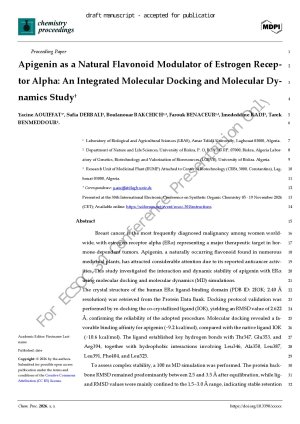
Breast cancer is the most frequently diagnosed malignancy among women worldwide, with estrogen receptor alpha (ERα) representing a major therapeutic target in hormone-dependent tumors. Apigenin, a naturally occurring flavonoid found in numerous medicinal plants, has attracted considerable attention due to its reported anticancer activities. This study investigated the interaction and dynamic stability of apigenin with ERα using molecular docking and molecular dynamics (MD) simulations.
The crystal structure of the human ERα ligand-binding domain (PDB ID: 2IOK; 2.40 Å resolution) was retrieved from the Protein Data Bank. Docking protocol validation was performed by re-docking the co-crystallized ligand (IOK), yielding an RMSD value of 2.622 Å, confirming the reliability of the adopted procedure. Molecular docking revealed a favorable binding affinity for apigenin (−9.2 kcal/mol), compared with the native ligand IOK (−10.6 kcal/mol). The ligand established key hydrogen bonds with Thr347, Glu353, and Arg394, together with hydrophobic interactions involving Leu346, Ala350, Leu387, Leu391, Phe404, and Leu525.
To assess complex stability, a 100 ns MD simulation was performed. The protein backbone RMSD remained predominantly between 2.5 and 3.5 Å after equilibration, while ligand RMSD values were mainly confined to the 1.5–3.0 Å range, indicating stable retention within the binding pocket. RMSF analysis showed limited fluctuations for most binding-site residues, and persistent interactions involving Glu353, Thr347, Arg394, and Phe404 were maintained throughout the simulation. These findings suggest that apigenin forms a stable ERα complex and may serve as a promising natural lead for hormone-dependent breast cancer drug discovery.
Keywords
Apigenin
Estrogen Receptor Alpha (ERα)
Breast Cancer
Molecular Docking
Molecular Dynamics Simulation.
Manuscript
[Sciforum-203170] - [Manuscript PDF] - [Submission accepted].pdf
Efficient synthesis of novel α-aminophosphonates as potential anticancer agents. Molecular docking and DFT/ADMET analyses
Essential oils as natural alternatives against phytopathogenic Xanthomonas campestris