Event submissions
Published
This submission belongs to the session Session 2. Chemistry of Bioorganics, Medicinal and Natural Products of the event The 30th International Electronic Conference on Synthetic Organic Chemistry
Published date
02 Nov, 2026
Academic Editor
 Julio A. Seijas
Citation
Guilherme Gaspar, Leonor Cruz, Omar Vergara-Diaz, Dora Martins Teixeira, Jorge M. S. Faria, Essential oils as natural alternatives against phytopathogenic Xanthomonas campestris, in Proceedings of The 30th International Electronic Conference on Synthetic Organic Chemistry, 5 November–19 November 2026, MDPI: Basel, Switzerland
Share
Email
Facebook
Twitter
LinkedIn
Essential oils as natural alternatives against phytopathogenic Xanthomonas campestris

Guilherme Gaspar 1
Leonor Cruz 1,2
Omar Vergara-Diaz 3
Dora Martins Teixeira 4,5

Jorge M. S. Faria 1,6
1. INIAV, I.P., National Institute for Agrarian and Veterinary Research, Phytobacteriology Laboratory, Quinta do Marquês, 2780-159 Oeiras, Portugal.
2. BioISI - Biosystems & Integrative Sciences Institute, Faculdade de Ciências da Universidade de Lisboa, Campo Grande, Lisboa 1749-016, Portugal
3. Plant Ecophysiology and Metabolism Group, Instituto de Tecnologia Química e Biológica António Xavier, Universidade Nova de Lisboa (ITQB NOVA), Av. da República, 2780-157 Oeiras, Portugal
4. HERCULES Laboratory, Évora University, Largo Marquês de Marialva 8, 7000-809 Évora, Portugal.
5. Science and Technology School of Évora University, Rua Romão Ramalho nº59, 7000-671 Évora, Portugal.
6. GREEN-IT Bioresources for Sustainability, ITQB NOVA, Av. da República, 2780-157 Oeiras, Portugal
Abstract
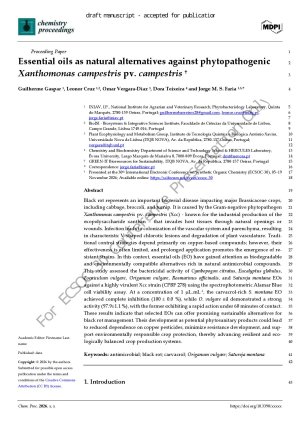
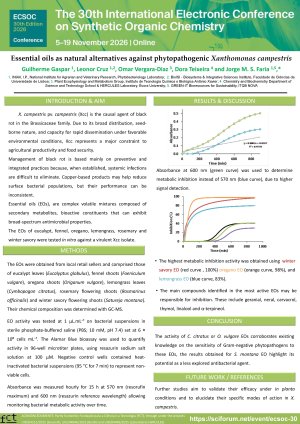
Black rot represents an important bacterial disease impacting major Brassicaceae crops, including cabbage, broccoli, and turnip. It is caused by the gram-negative phytopathogen Xanthomonas campestris - known for the industrial production of the exopolysaccharide xanthan – that invades host tissues through natural openings or wounds. Infection leads to colonization of the vascular system and parenchyma, resulting in characteristic V-shaped chlorotic lesions and degradation of plant vasculature. Traditional control strategies depend primarily on copper-based compounds; however, their effectiveness is often limited, and prolonged application promotes the emergence of resistant strains. In this context, essential oils (EO) have gained attention as biodegradable and environmentally compatible alternatives rich in natural antimicrobial compounds. This study assessed the bactericidal activity of Cymbopogon citratus, Eucalyptus globulus, Foeniculum vulgare, Origanum vulgare, Rosmarinus officinalis, and Satureja montana EOs against a highly virulent X. campestris isolate (CPBF 278) using the spectrophotometric Alamar Blue cell viability assay. At a concentration of 1 µL.mL-1, the carvacrol rich S. montana essential oil achieved complete inhibition (100 ± 0.0%), while O. vulgare oil demonstrated a strong activity (88.8 ± 4.1%), with the former exhibiting a rapid action within 15–30 minutes of contact. These results indicate that selected EOs can offer promising sustainable alternatives for black rot management. Their development as potential phytosanitary products could lead to reduced dependence on copper bactericides, minimize resistance development, and support environmentally responsible crop protection, thereby advancing resilient and ecologically balanced crop production systems.
Keywords
antimicrobial
black rot
carvacrol
Origanum vulgare
Satureja montana
Manuscript
[Sciforum-203256] - [Manuscript PDF] - [Submission accepted].pdf
Poster
[Sciforum-203256] - [Poster] - [Submission accepted].pdf
Apigenin as a Natural Flavonoid Modulator of Estrogen Receptor Alpha: An Integrated Molecular Docking and Molecular Dynamics Study
Solid-Phase Synthetic Approaches to C-Terminal and Backbone-Modified Peptide Analogues for Drug Discovery