Event submissions
Published
This submission belongs to the session Session 2. Chemistry of Bioorganics, Medicinal and Natural Products of the event The 30th International Electronic Conference on Synthetic Organic Chemistry
Published date
02 Nov, 2026
Academic Editor
 Julio A. Seijas
Citation
Bita Norouzi, Arash Maghsoudlou, Maryam Tabarzad, Tahereh Hosseinabadi, Arash Mahboubi, RSM-Optimized Green Synthesis of Ag/AgCl–Cu–MgO Nanocomposites to Enhance Their Antimicrobial Activity against methicillin-resistant Staphylococcus aureus (MRSA), in Proceedings of The 30th International Electronic Conference on Synthetic Organic Chemistry, 5 November–19 November 2026, MDPI: Basel, Switzerland
Share
Email
Facebook
Twitter
LinkedIn
RSM-Optimized Green Synthesis of Ag/AgCl–Cu–MgO Nanocomposites to Enhance Their Antimicrobial Activity against methicillin-resistant Staphylococcus aureus (MRSA)

Bita Norouzi 1
Arash Maghsoudlou 1
Maryam Tabarzad 2
Tahereh Hosseinabadi 3
Arash Mahboubi 4
1. Department of Pharmaceutics and Pharmaceutical Nanotechnology, School of Pharmacy, Shahid Beheshti University of Medical Sciences, Tehran, Iran.
2. Protein Technology Research Center, Shahid Beheshti University of Medical Sciences, Tehran, Iran.
3. Department of Pharmacognosy, School of Pharmacy, Shahid Beheshti University of Medical Sciences, Tehran, Iran.
4. Department of Pharmaceutics, School of Pharmacy, Pharmaceutical Sciences Research Center, Shahid Beheshti University of Medical Sciences, Tehran, Iran
Abstract
Introduction:
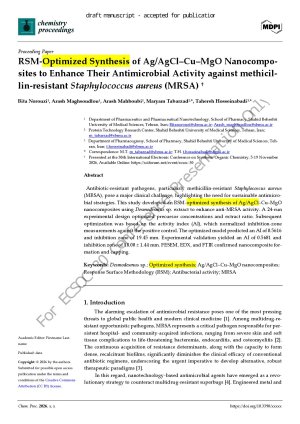
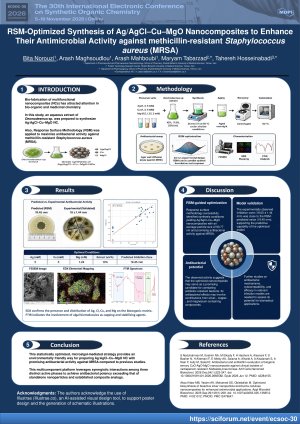
Bio-fabrication of multifunctional nanocomposites (NCs) has attracted attentions in bio-organic and medicinal chemistry. In this study, an aqueous extract of Desmodesmus sp. was prepared to greenly synthesized Ag/AgCl–Cu–MgO NC. Also, Response Surface Methodology (RSM) was applied to maximize antibacterial activity against methicillin-resistant Staphylococcus aureus (MRSA).
Methods:
An experimental design (24 runs) was developed, which included precursor salts concentration (Mg, 0.5, 1.25, and 2 Mm, Cu and Ag, 1, 3, and 5 mM) and Desmodesmus sp. extract concentration (10, 17.5, and 25%). The mixtures were stirred for 3 hours at 50°C under alkaline conditions, and they were centrifuged after overnight aging, and calcinated at 60°C. Antibacterial activity, assessed by agar well diffusion assay. RSM predicted the optimum formulation, then experimentally validated. The optimized NC was characterized by FESEM, EDX mapping, and FTIR analysis.
Results:
Predicted inhibition zone was [19.45] mm with optimal condition (Ag 5 Mm, Cu 5 Mm, Mg 1.24 Mm, Extract 10% v/v), while the experimentally validated value was [18 ± 1.44] mm, indicating good agreement between model and experiment. The model showed satisfactory fit with R2 = [0.79]. FESEM showed average size of 90.77 nm and EDX mapping confirmed the composite distribution of Ag, Cl, Cu, Mg on bioorganic matrix, while FTIR demonstrated algal biomolecules as capping and stabilizer.
Conclusion:
This statistically optimized, microalgal-mediated strategy provides an environmentally friendly way for preparing Ag/AgCl–Cu–MgO NC with promising antibacterial activity against MRSA compared to previous studies.
Keywords
Green synthesis
Desmodesmus sp
Nanocomposites
Response Surface Methodology
Antibacterial activity
MRSA
Manuscript
[Sciforum-205475] - [Manuscript PDF] - [Submission accepted].pdf
Poster
Poster-ecos.pdf
Solid-Phase Synthetic Approaches to C-Terminal and Backbone-Modified Peptide Analogues for Drug Discovery
New pathways for substituted pyrimidines: Influence of tantalum catalysis on the chemoselectivity of alkyne-nitrile reactions