Event submissions
Published
This submission belongs to the session Session 1. General Organic Synthesis of the event The 30th International Electronic Conference on Synthetic Organic Chemistry
Published date
02 Nov, 2026
Academic Editor
 Julio A. Seijas
Citation
Maria G Shaibakova, Ilfir R Ramazanov, Elvira I Tukaeva, Leisan K Dil'mukhametova, New pathways for substituted pyrimidines: Influence of tantalum catalysis on the chemoselectivity of alkyne-nitrile reactions, in Proceedings of The 30th International Electronic Conference on Synthetic Organic Chemistry, 5 November–19 November 2026, MDPI: Basel, Switzerland
Share
Email
Facebook
Twitter
LinkedIn
New pathways for substituted pyrimidines: Influence of tantalum catalysis on the chemoselectivity of alkyne-nitrile reactions

Maria G Shaibakova 1
Ilfir R Ramazanov 1
Elvira I Tukaeva 1
Leisan K Dil'mukhametova 1
1. Institute of petrochemistry and catalysis, Ufa Federal Researcher Centre of the Russian Academy of Sciences, Ufa, Russia
Abstract
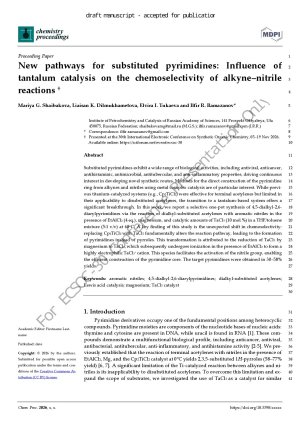
Substituted pyrimidines exhibit a wide range of biological activities, including antiviral, anticancer, antihistaminic, antimicrobial, antitubercular, and anti-inflammatory properties, driving continuous interest in developing novel synthetic routes. Methods for the direct construction of the pyrimidine ring from alkynes and nitriles using metal complex catalysis are of particular interest. While previous titanium-catalyzed systems (e.g., Cp2TiCl2) were effective for terminal acetylenes but limited in their applicability to disubstituted acetylenes, the transition to a tantalum-based system offers a significant breakthrough. In this work, we report a selective one-pot synthesis of 4,5-dialkyl-2,6-diarylpyrimidines via the reaction of dialkyl-substituted acetylenes with aromatic nitriles in the presence of EtAlCl2 (4 eq.), magnesium, and catalytic amounts of TaCl5 (10 mol.%) in a THF/toluene mixture (5:1 v/v) at 60oC. A key finding of this study is the unexpected shift in chemoselectivity: replacing Cp2TiCl2 with TaCl5 fundamentally alters the reaction pathway, leading to the formation of pyrimidines instead of pyrroles. This transformation is attributed to the reduction of TaCl5 by magnesium to TaCl4, which subsequently undergoes ionization in the presence of EtAlCl2 to form a highly electrophilic TaCl3+
cation. This species facilitates the activation of the nitrile group, enabling the efficient construction of the pyrimidine core. The target pyrimidines were obtained in yields ranging from 30–58%.
Keywords
aromatic nitriles
4,5-dialkyl-2,6-diarylpyrimidines
dialkyl-substituted acetylenes
Lewis acid catalysis
magnesium
TaCl5 catalyst
Manuscript
[Sciforum-202223] - [Manuscript PDF] - [Submission accepted].pdf
RSM-Optimized Green Synthesis of Ag/AgCl–Cu–MgO Nanocomposites to Enhance Their Antimicrobial Activity against methicillin-resistant Staphylococcus aureus (MRSA)
Phytochemical Diversity and Antioxidant Potential of Indigenous Zimbabwean Fruits: Strychnos madagascariensis and Parinari curatellifolia as Underutilised Plant Resources