Event submissions
Published
This submission belongs to the session Session 2. Chemistry of Bioorganics, Medicinal and Natural Products of the event The 30th International Electronic Conference on Synthetic Organic Chemistry
Published date
02 Nov, 2026
Academic Editor
 Julio A. Seijas
Citation
Memory Mhlanga, Kurai Gareth Mawoneke, Humphrey Masimba Makumbirofa, Phytochemical Diversity and Antioxidant Potential of Indigenous Zimbabwean Fruits: Strychnos madagascariensis and Parinari curatellifolia as Underutilised Plant Resources
, in Proceedings of The 30th International Electronic Conference on Synthetic Organic Chemistry, 5 November–19 November 2026, MDPI: Basel, Switzerland
Share
Email
Facebook
Twitter
LinkedIn
Phytochemical Diversity and Antioxidant Potential of Indigenous Zimbabwean Fruits: Strychnos madagascariensis and Parinari curatellifolia as Underutilised Plant Resources

Memory Mhlanga 1

Kurai Gareth Mawoneke 2

Humphrey Masimba Makumbirofa 1
1. Department of Pharmaceutical Technology, School of Allied Health Sciences, Harare Institute of Technology, Belvedere, Harare, Zimbabwe
2. Department of Food Processing Technology, School of Industrial Sciences and Technology, Harare Institute of Technology, Belvedere, Harare, Zimbabwe
Abstract
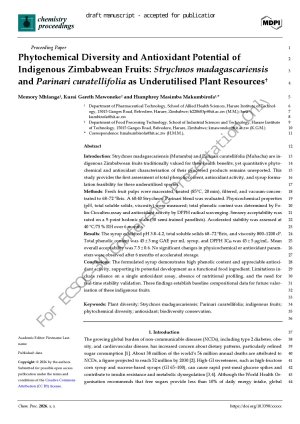
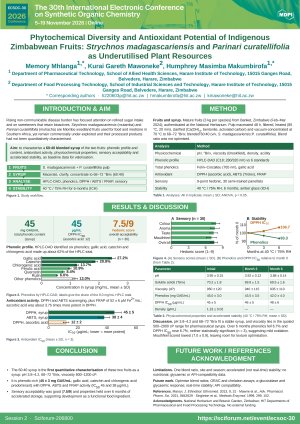
Introduction: Strychnos madagascariensis (Mutamba) and Parinari curatellifolia (Muhacha) are indigenous Zimbabwean fruits traditionally valued for their health benefits, yet quantitative phytochemical and antioxidant characterisation of their processed products remains unreported. This study provides the first assessment of total phenolic content, antioxidant activity, and syrup formulation feasibility for these underutilised species.
Methods: Fresh fruit pulps were macerated, heated (85°C, 20 min), filtered, and vacuum-concentrated to 68–72 °Brix. A 60:40 Strychnos: Parinari blend was evaluated. Physicochemical properties (pH, total soluble solids, viscosity) were measured; total phenolic content was determined by Folin‑Ciocalteu assay and antioxidant activity by DPPH radical scavenging. Sensory acceptability was rated on a 9‑point hedonic scale (30 semi‑trained panellists). Accelerated stability was assessed at 40 °C/75 % RH over 6 months.
Results: The syrup exhibited pH 3.8–4.2, total soluble solids 68–72 °Brix, and viscosity 800–1200 cP. Total phenolic content was 45 ± 3 mg GAE per mL syrup, and DPPH IC₅₀ was 45 ± 5 µg/mL. Mean overall acceptability was 7.5 ± 0.6. No significant changes in physicochemical or antioxidant parameters were observed after 6 months of accelerated storage.
Conclusions: The formulated syrup demonstrates high phenolic content and appreciable antioxidant activity, supporting its potential development as a functional food ingredient. Limitations include reliance on a single antioxidant assay, absence of nutritional profiling, and the need for real‑time stability validation. These findings establish baseline compositional data for future valorisation of these indigenous fruits.
Keywords
Plant diversity
Strychnos madagascariensis
Parinari curatellifolia
indigenous fruits
phytochemical diversity
antioxidant
biodiversity conservation
Manuscript
[Sciforum-206800] - [Manuscript PDF] - [Submission accepted].pdf
Poster
Zimbabwean Fruits Syrup Poster.pdf
New pathways for substituted pyrimidines: Influence of tantalum catalysis on the chemoselectivity of alkyne-nitrile reactions
Studies of the Antioxidant Mechanisms Produced by Black Raspberries extracts (Rubus niveus Thunb) and Magnesium Salts Mixtures in Red Blood Cells.