Event submissions
Published
This submission belongs to the session Session 2. Chemistry of Bioorganics, Medicinal and Natural Products of the event The 30th International Electronic Conference on Synthetic Organic Chemistry
Published date
02 Nov, 2026
Academic Editor
 Julio A. Seijas
Citation
María Alejandra Rodríguez, Daniela Kenayfati, Xiomara Rodríguez, FORMULATION OF SOY LECITHIN-BASED LIPOSOMES AS A CONTROLLED DELIVERY VEHICLE FOR METHOTREXATE, in Proceedings of The 30th International Electronic Conference on Synthetic Organic Chemistry, 5 November–19 November 2026, MDPI: Basel, Switzerland
Share
Email
Facebook
Twitter
LinkedIn
FORMULATION OF SOY LECITHIN-BASED LIPOSOMES AS A CONTROLLED DELIVERY VEHICLE FOR METHOTREXATE

María Alejandra Rodríguez 1
Daniela Kenayfati 1
Xiomara Rodríguez 2
1. Energía y Automatización, Universidad Metropolitana, Caracas, 1073, Venezuela
2. Facultad de Medicina, Universidad de Carabobo, Valencia, 2005, Venezuela
Abstract
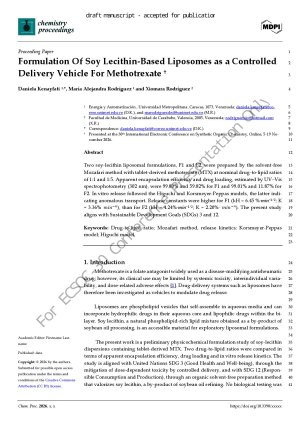
Liposomes are spherical vesicles composed of phospholipids that spontaneously self-assemble in aqueous media to form a lipid bilayer with an internal aqueous core. These nanocarriers can successfully encapsulate drugs with low bioavailability and high toxicity, such as methotrexate, which is widely recognized for its potent antiproliferative and anti-inflammatory effects. This research work aimed to evaluate the encapsulation efficiency of methotrexate in soy lecithin-based liposomes to develop an optimized controlled delivery vehicle. The experimental design involved formulating liposomes with drug-to-lipid weight ratios of 1:1 and 1:5 using the Mozafari method. Encapsulation efficiency was determined via UV-Vis spectrophotometry, applying the Beer-Lambert law to quantify the unencapsulated drug from the absorbance at 302 nm. Following sample centrifugation, the 1:1 ratio yielded an outstanding encapsulation efficiency of 99.80% and a drug loading capacity of 59.82%, while the 1:5 ratio achieved 99.01% efficiency and 11.87% loading capacity. Controlled release tests were systematically conducted, collecting samples over time to quantify drug concentration. The Korsmeyer-Peppas model revealed that both formulations exhibited an anomalous transport release mechanism; the 1:1 formulation showed a higher release constant (3.36 min-1) than the 1:5 system (2.20 min-1). Similarly, the Higuchi kinetic constant was higher in the 1:1 formulation (6.45% min-0.5) than in the 1:5 blend (4.24% min-0.5), indicating that the 1:5 formulation provided a significantly more controlled drug release profile.
Keywords
liposome
controlled delivery vehicle
methotrexate
soy lecithin
Mozafari method.
Manuscript
[Sciforum-207432] - [Manuscript PDF] - [Submission accepted].pdf
Poster
Video Contribution - SciForum 207432 (1).mp4
DEVELOPMENT OF A PLANT EXTRACT-BASED SUNSCREEN FORMULATION
The Design and Synthesis of a Novel Series of Bis-2-Aminopyridines