Event submissions
Published
This submission belongs to the session Session 2. Chemistry of Bioorganics, Medicinal and Natural Products of the event The 30th International Electronic Conference on Synthetic Organic Chemistry
Published date
02 Nov, 2026
Academic Editor
 Julio A. Seijas
Citation
Patricia Saputelli, María Alejandra Rodríguez, EXTRACTION OF BEETROOT COLORANT FOR ITS INCORPORATION INTO A LIP BALM, in Proceedings of The 30th International Electronic Conference on Synthetic Organic Chemistry, 5 November–19 November 2026, MDPI: Basel, Switzerland
Share
Email
Facebook
Twitter
LinkedIn
EXTRACTION OF BEETROOT COLORANT FOR ITS INCORPORATION INTO A LIP BALM

Patricia Saputelli 1
María Alejandra Rodríguez 1
1. Faculty of Engineering, Department of Energy and Automation, Universidad Metropolitana, Caracas 1073, Venezuela
Abstract
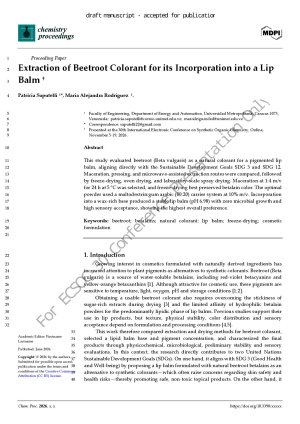
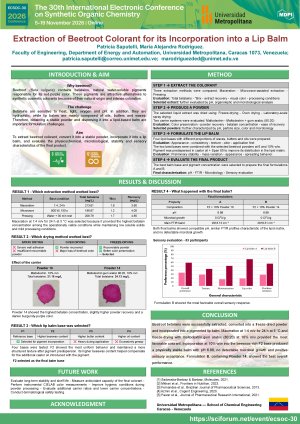
This study aimed to extract the natural colorant from beetroot (Beta vulgaris) for its subsequent incorporation into a lip balm as a natural, sustainable, and innovative cosmetic alternative aligned with Sustainable Development Goals (SDGs) 3 and 12. Three pigment extraction methods (maceration, pressing, and microwave-assisted extraction) were evaluated, considering parameters such as betalain content, Brix degrees, extraction yield, and operational feasibility. The selected extract was fully characterized through organoleptic, physicochemical, and microbiological tests, and then subjected to three distinct drying methods: lyophilization, oven drying, and spray drying, using maltodextrin and a maltodextrin/gum arabic mixture as encapsulating agents. Two of the obtained powder colorants were thoroughly evaluated through physicochemical, microbiological, and colorimetric analyses to select the one with the best overall performance. Results determined that maceration (1:4 w/v ratio, 24 h at 5 °C) and lyophilization were the most effective extraction and drying methods, respectively. The powder with the highest performance was obtained using the maltodextrin and gum arabic mixture (80:20 ratio) at a total concentration of 10% w/v. This colorant was successfully incorporated into a lip balm lipid base, and the final formulation was characterized via preliminary stability, pH, Fourier-transform infrared spectroscopy (FTIR), microbiological analysis, and sensory evaluation. In conclusion, the beetroot colorant demonstrated excellent technical viability for use in pigmented lip cosmetics, exhibiting favorable stability, adequate microbiological quality, and positive sensory acceptance by users.
Keywords
beetroot
betalains
lip balm
natural colorant
cosmetic formulation.
Manuscript
[Sciforum-207433] - [Manuscript PDF] - [Submission accepted].pdf
Poster
[Sciforum-207433] - [Poster] - [Submission accepted].pdf
The Design and Synthesis of a Novel Series of Bis-2-Aminopyridines
Ecdysteroid analogs based on halogenated derivatives of steroidal sapogenins