Event submissions
Published
This submission belongs to the session Session 2. Chemistry of Bioorganics, Medicinal and Natural Products of the event The 30th International Electronic Conference on Synthetic Organic Chemistry
Published date
02 Nov, 2026
Academic Editor
 Julio A. Seijas
Contribution&Funding
Methodology,
[EVER ARQUIMEDES BLÉ GONZALEZ]
Writing - original draft,
[Mariana Gonzalez Cupido]
Supervision,
[EVER ARQUIMEDES BLÉ GONZALEZ]
Project administration,
[EVER ARQUIMEDES BLÉ GONZALEZ]
Funding: --
Citation
Mariana Gonzalez Cupido, Quirino Torres-Sauret, EVER ARQUIMEDES BLÉ GONZALEZ, Influence of Sequential Solvent Extraction on the Antibacterial Activity of Origanum vulgare Leaf Extracts, in Proceedings of The 30th International Electronic Conference on Synthetic Organic Chemistry, 5 November–19 November 2026, MDPI: Basel, Switzerland
Share
Email
Facebook
Twitter
LinkedIn
Influence of Sequential Solvent Extraction on the Antibacterial Activity of Origanum vulgare Leaf Extracts

Mariana Gonzalez Cupido 1
Quirino Torres-Sauret 1
EVER ARQUIMEDES BLÉ GONZALEZ 1
1. División Académica de Ciencias Básicas, Universidad Juárez Autónoma de Tabasco, Cunduacán, 86690, Mexico
Abstract
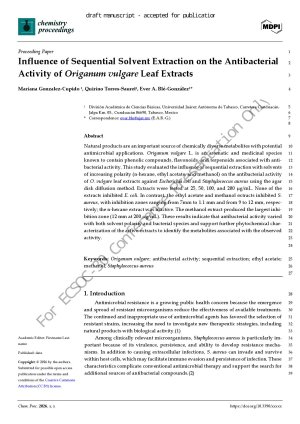
Natural products remain an invaluable source of structurally diverse molecules with promising pharmaceutical applications. Origanum vulgare L. is an aromatic and medicinal species rich in phenolic monoterpenes, flavonoids, and other specialized metabolites associated with antimicrobial activity. In this study, the influence of sequential solvent extraction on the recovery of antibacterial metabolites from O. vulgare leaf extracts was investigated using solvents of increasing polarity (n-hexane, ethyl acetate, and methanol). The resulting crude extracts were evaluated against Escherichia coli by the agar disk diffusion method at concentrations of 200, 100, 50, 25, and 12.5 mg/mL. None of the extracts produced inhibition zones against E. coli, whereas the positive controls (doxycycline and ceftriaxone) exhibited inhibition halos ranging from 2.0 to 3.3 cm, confirming the reliability of the assay. The lack of antibacterial activity against this Gram-negative bacterium is likely associated with the permeability barrier of the outer membrane, which limits the penetration of hydrophobic phytochemicals. Previous studies have demonstrated that ethanolic extracts and essential oils of O. vulgare, rich in carvacrol and thymol, exhibit significant antibacterial activity against Staphylococcus aureus, producing inhibition zones of up to 2.16 cm. These findings emphasize the influence of solvent polarity on the extraction of bioactive metabolites and provide a foundation for future phytochemical characterization and bioactivity-guided fractionation to identify the compounds responsible for the antibacterial properties of O. vulgare.
Keywords
Origanum vulgare; Antibacterial activity; Natural products; Bioactive metabolites; Gram-negative bacteria.
Manuscript
[Sciforum-207780] - [Manuscript PDF] - [Submission accepted].pdf
Mass Spectrometric Characterization, Antioxidant Activity, and Computational Investigation of Styrene–Carboxyphenylmaleimide Copolymers
New efficient bifunctional catalysts for condensation: (2-(pyridin-2-yl)ethyl)phosphonic acid and (2-(pyridin-4-yl)ethyl)phosphonic acid grafted on alumina (Al2-pyrPA and Al4-pyrPA)