Event submissions
Published
This submission belongs to the session Session 1. General Organic Synthesis of the event The 30th International Electronic Conference on Synthetic Organic Chemistry
Published date
02 Nov, 2026
Academic Editor
 Julio A. Seijas
Citation
Juan Enrique Tacoronte Morales, Jhon Walter Muñoz, Catalytic Synthesis of Secospirostanes A and B from (25R)-Spirost-5-en-3β-ol, a natural sapogenin, in Proceedings of The 30th International Electronic Conference on Synthetic Organic Chemistry, 5 November–19 November 2026, MDPI: Basel, Switzerland
Share
Email
Facebook
Twitter
LinkedIn
Catalytic Synthesis of Secospirostanes A and B from (25R)-Spirost-5-en-3β-ol, a natural sapogenin

Juan Enrique Tacoronte Morales 1,2
Jhon Walter Muñoz 1
1. Green Science Laboratory. Green Chemistry & Envirronmental Division. Isaac Newton 1B, Quito, PC 170202 Ecuador
2. IT-learning Konsult. Environmental and Education Division, Svedje 272, PC 84572, Bern Kommun. Jamtland, Sweden
Abstract
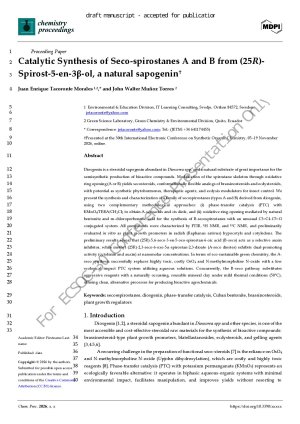
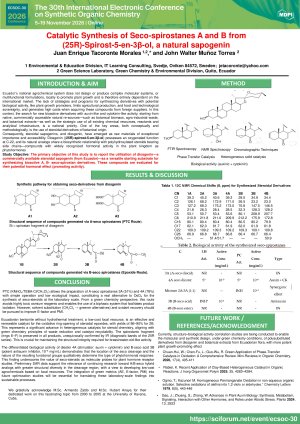
Diosgenin is a steroidal sapogenin abundant in Dioscorea spp. and a natural substrate of great importance for the semisynthetic production of bioactive compounds. Modification of the spirostane skeleton through oxidative ring opening (A or B) yields secosteroids, conformationally flexible analogs of brassinosteroids and ecdysteroids, with potential as synthetic phytohormones, therapeutic agents, and ecdysis modulators for insect control. We present the synthesis and characterization of a family of secospirostanes (types A and B) derived from diosgenin, using two complementary methodological approaches: (i) phase-transfer catalysis (PTC) with KMnO₄/TEBA/CH₂Cl₂ to obtain A-secoacids and cis diols, and (ii) oxidative ring-opening mediated by natural bentonite and m-chloroperbenzoic acid for the synthesis of B-secospirostanes with an unusual C3=C4-C5=O conjugated system. All compounds were characterized by FTIR, ¹H NMR, and ¹³C NMR, and preliminarily evaluated in vitro as plant growth promoters in radish (Raphanus sativus) hypocotyls and cotyledons. The preliminary results reveal that (25R)-5,6-seco-3-en-5-oxo-spirostan-6-oic acid (B-seco) acts as a selective auxin inhibitor, while methyl (25R)-2,3-seco-6-oxo-5α-spirostan-2,3-dioate (A-seco diester) exhibits dual-promoting activity (cytokinin and auxin) at nanomolar concentrations.
In terms of eco-sustainable green chemistry, the A-seco synthesis successfully replaces highly toxic, costly OsO₄ and N-methylmorpholine N-oxide with a low ecological impact PTC system utilizing aqueous solutions. Concurrently, the B-seco pathway substitutes aggressive reagents with a naturally occurring, reusable mineral clay under mild thermal conditions (50°C), offering clean, alternative processes for producing bioactive agrochemicals.
Keywords
catalysis
sapogenins
green chemistry
secosteroids
biological activity
Manuscript
[Sciforum-202402] - [Manuscript PDF] - [Submission accepted].pdf
Poster
[Sciforum-202402] - [Poster] - [Submission accepted].pdf
In Silico Investigation, Synthesis, Spectroscopic Characterization, Molecular Docking, and ADME Analysis of a Anthracene-Based Chalcone Targeting EGFR Tyrosine Kinase
Synthesis of Cellulose Acetate from Banana Rachis Residues