Event submissions
Published
This submission belongs to the session Session 1. General Organic Synthesis of the event The 30th International Electronic Conference on Synthetic Organic Chemistry
Published date
02 Nov, 2026
Academic Editor
 Julio A. Seijas
Citation
Tao Li, Patricia Lerena, Maria Eugenia Martín, Alicia Clement, Victoria Valdivia, Rocío Recio, Inmaculada Fernández, Stereochemical Tuning in CF₃-Sulfinyl Transfer: Glucose-Derived Sulfinates toward Chiral Sulforaphane Isosteres, in Proceedings of The 30th International Electronic Conference on Synthetic Organic Chemistry, 5 November–19 November 2026, MDPI: Basel, Switzerland
Share
Email
Facebook
Twitter
LinkedIn
Stereochemical Tuning in CF3-Sulfinyl Transfer: Glucose-Derived Sulfinates toward Chiral Sulforaphane Isosteres

Tao Li 1
Patricia Lerena 1
Maria Eugenia Martín 1
Alicia Clement 1
Victoria Valdivia 1
Rocío Recio 1
Inmaculada Fernández 1
1. Department of Organic and Pharmaceutical Chemistry. Faculty of Pharmacy. University of Seville. Seville 41012. Spain
Abstract
Introduction
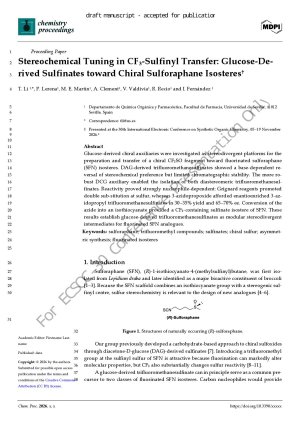
Chiral trifluoromethyl sulfoxides are underexplored fluorinated sulfur motifs with growing relevance in asymmetric synthesis and medicinal chemistry. In the scaffold of the phytochemical sulforaphane replacement of CH3SO group by a CF3SO unit provides a direct fluorinated isostere, but requires a stereochemically controlled transfer.
Methods
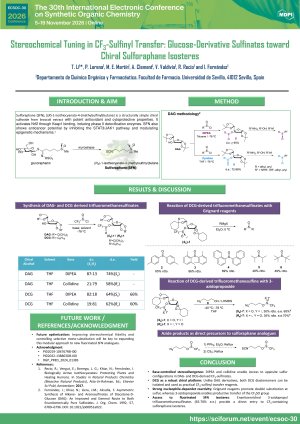
Trifluoromethanesulfinyl chloride was reacted with glucose-derived chiral alcohols under different base and solvent conditions. Although base-controlled stereodifferentiation is well established for related alkylsulfinyl chlorides, trifluoromethanesulfinyl chloride required specific re-optimization because of its distinct reactivity profile. DAG-derived sulfinates were used to evaluate base-dependent stereochemical induction, whereas the more robust DCG platform was selected because its diastereomeric trifluoromethanesulfinates could be purified by silica gel column chromatography. Diastereomeric ratios were determined by 1H NMR. Enantiomeric excesses were measured by chiral HPLC.
Results
DAG screening showed complementary stereochemical bias: DIPEA/THF favored Ss-sulfinate, whereas collidine/THF favored Rs derivative. However, DAG sulfinates showed limited stability toward silica gel. Fortunatelly, DCG enabled chromatographic isolation of both diastereomeric trifluoromethanesulfinates, affording the Ss- and Rs- epimers in 66% and 60% yield, respectively. Grignard reagents mainly afforded symmetrical sulfoxides through double nucleophilic substitution at sulfur. Conversely, 3-azidopropoxide underwent productive CF3-sulfinyl transfer, giving enantioenriched 3-azidopropyl trifluoromethanesulfinates in 30–35% yield and 65–70% ee. Subsequent azido-to-isothiocyanate conversion enabled access to the CF3-sulfinyl sulforaphane isostere.
Conclusions
Glucose-derived trifluoromethanesulfinates provide an enantiodivergent platform for CF3-sulfinyl transfer. Although double substitution at sulfur remains the main limitation, the synthesis of enantioenriched sulforaphane isosteres validates this strategy for fluorinated chiral sulfoxide design.
Acknowledgment
PID2019-104767RB-I00/AEI/10.13039/501100011033) and DGP_PRED_2024_01383.
Keywords
Asymmetric Synthesis
Chiral sulfinates
trifluoromethyl derivatives
chiral sulfoxides
biologically active compounds.
Manuscript
[Sciforum-202719] - [Manuscript PDF] - [Submission accepted].pdf
Poster
[Sciforum-202719] - [Poster] - [Submission accepted].pdf
Beyond Monoaddition: Stereodivergent Ethyl Acetate Enolate Additions to N-tert-Butanesulfinyl Imines toward Chiral 1,3-Bis-sulfinamide Ligands and Diamines
Synthesis of new thiopyrano[2,3-d]thiazole-2-thiones as potential pharmacological agents