Event submissions
Published
This submission belongs to the session Session 1. General Organic Synthesis of the event The 30th International Electronic Conference on Synthetic Organic Chemistry
Published date
02 Nov, 2026
Academic Editor
 Julio A. Seijas
Citation
Arlette Urías-Benavides, Eduardo Peña-Cabrera, Diana E. Ramírez-Ornelas, Synthesis of water-soluble BODIPYs: BODIPY-PEG†, in Proceedings of The 30th International Electronic Conference on Synthetic Organic Chemistry, 5 November–19 November 2026, MDPI: Basel, Switzerland
Share
Email
Facebook
Twitter
LinkedIn
Synthesis of water-soluble BODIPYs: BODIPY-PEG†

Arlette Urías-Benavides 1
Eduardo Peña-Cabrera 1
Diana E. Ramírez-Ornelas 1
1. Departamento de Química, División de Ciencias Naturales y Exactas, Campus Guanajuato, Universidad de Guanajuato, Guanajuato, Gto., México
Abstract
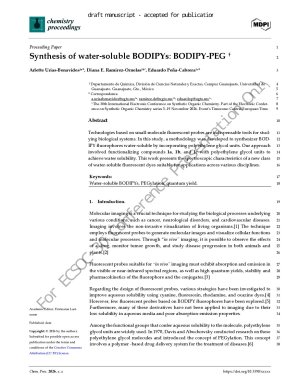
Applications of BODIPY fluorophores have enabled the expansion of research in modern biomedicine. The characteristics required for their use as fluorescent probes include excitation and emission wavelengths in the near-infrared range (600–800 nm), low biotoxicity, high quantum yields, and water solubility. This last requirement is fundamental for biomedical research, such as in photodynamic therapy, cell labeling, and chemosensors. This work focuses on the design and synthesis of fluorescent molecules that are soluble in aqueous media.
In 1970, Davis and Abuchowsky conducted research on polyethylene glycol molecules and introduced the concept of PEGylation. Polyethylene glycol molecules have been found to provide excellent solubility.
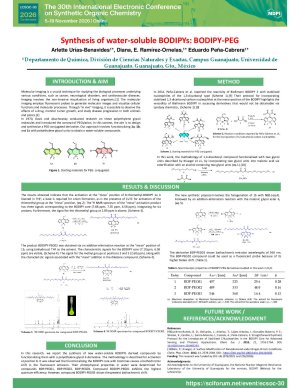
Our approach involves functionalizing compounds 1a, 1b, and 1c with a polyethylene glycol unit to yield a family of water-soluble compounds (Figure 1).
First, a polyethylene glycol unit was synthesized using the methodology described by Krueger et al. two glycol units were incorporated into malonic acid via esterification with an alcohol containing two glycol units (Eq. 1). The malonic glycol ester 3 was successfully obtained, as confirmed by 1H and 13C NMR experiments (Figure 1A).
Regarding the incorporation of the malonic glycol ester into 8-methylthioBODIPY, the methodology described by the Peña-Cabrera group for the addition of active methylenes at the meso position of the BODIPY core was adopted.
This research successfully achieved the synthesis of a new family of water-soluble BODIPY dyes through functionalization with a polyethylene glycol derivative.
Reference
1. Knop, K.; Hoogenboom, R.; Fisher, D.; Schubert, U. S.; Chem. Int. 2010, 49, 6288.
Keywords
Water-soluble BODIPYs
PEGylation
quantum yield.
Manuscript
[Sciforum-202820] - [Manuscript PDF] - [Submission accepted].pdf
Poster
[Sciforum-202820] - [Poster] - [Submission accepted].pdf
Phytochemical-Mediated Green Synthesis and Physicochemical Characterization of Cadmium Sulphide Nanocrystals from Morinda citrifolia with Antibacterial Activity Against Multidrug-Resistant Enterobacteriaceae
Deciphering the Antioxidant Potency and Bioactive Composition of Acanthus spinosus: A Quantitative and Qualitative Assessment