Event submissions
Published
This submission belongs to the session Session 2. Chemistry of Bioorganics, Medicinal and Natural Products of the event The 30th International Electronic Conference on Synthetic Organic Chemistry
Published date
02 Nov, 2026
Academic Editor
 Julio A. Seijas
Contribution&Funding
Methodology,
[Asma ALLAL] ; [Nassima Ramdani] ; [Zakia FEKIH]
Funding: --
Citation
Nadia FEKIH, Asma ALLAL, Nassima Ramdani, Zakia FEKIH, Deciphering the Antioxidant Potency and Bioactive Composition of Acanthus spinosus: A Quantitative and Qualitative Assessment, in Proceedings of The 30th International Electronic Conference on Synthetic Organic Chemistry, 5 November–19 November 2026, MDPI: Basel, Switzerland
Share
Email
Facebook
Twitter
LinkedIn
Deciphering the Antioxidant Potency and Bioactive Composition of Acanthus spinosus: A Quantitative and Qualitative Assessment

Nadia FEKIH 1,2
Asma ALLAL 1,2
Nassima Ramdani 1
Zakia FEKIH 1
1. Department of Material Science, Faculty of Sciences and Technology, University of Ain Temouchent, 46000 Ain Temouchent, Algeria
2. Department of Chemistry, Faculty of Science, Laboratory of Natural and Bioactive Substances LASNABIO, University of Tlemcen, 13000 Tlemcen, Algeria
Abstract
Introduction :
Acanthus spinosus is a prominent medicinal plant widely distributed across the Mediterranean region, traditionally utilized for its diverse therapeutic properties, most notably its anti-inflammatory effects. Despite its ethnobotanical significance, a comprehensive evaluation of its biochemical profile is essential for modern pharmacological applications. This study aims to characterize the fatty acid and unsaponifiable fractions and evaluate the antioxidant capacity of various plant extracts.
Methods :
Preliminary phytochemical screening was conducted to identify key secondary metabolites, including tocopherols, sterols, and terpenes. The total phenolic content (TPC) of the extracts was quantified using the Folin-Ciocalteu spectrophotometric method. The antioxidant potential was rigorously assessed through two complementary assays: the 2,2-diphenyl-1-picrylhydrazyl (DPPH) radical scavenging assay and the Ferric Reducing Antioxidant Power (FRAP) assay.
Results :
Qualitative analysis confirmed the presence of sterols, tocopherols, and terpenes. Quantitative results indicated that the ethanolic extracts of Acanthus spinosus are particularly rich in polyphenolic compounds. Among the tested fractions, the ethanolic extract exhibited the most potent antioxidant activity, demonstrating a significant DPPH radical scavenging capacity with an IC50 value of 0.0286 mg/ml. These findings were further corroborated by the FRAP assay, which revealed a high affinity for reducing Fe3+ ions, reinforcing the significant antioxidant potential of the extracts.
Conclusions :
This research highlights Acanthus spinosus as a rich source of bioactive polyphenols with robust antioxidant properties. The findings suggest that these extracts could serve as effective natural agents in the prevention of oxidative stress-related diseases and offer a foundation for future development in the pharmaceutical and nutraceutical industries.
Keywords
Acanthus spinosus; Phytochemical screening; Antioxidant activity; DPPH; FRAP
Manuscript
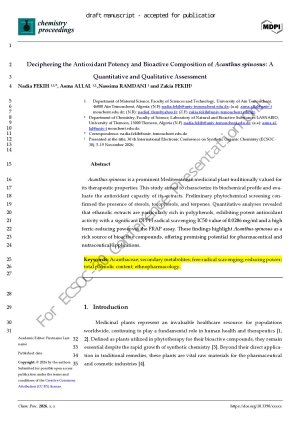
[Sciforum-208030] - [Manuscript PDF] - [Submission accepted].pdf
Synthesis of water-soluble BODIPYs: BODIPY-PEG†
Synthesis of new amide derivatives of phenolic acids with antioxidant properties for use in cosmetics