Event submissions
Published
This submission belongs to the session Session 1. General Organic Synthesis of the event The 30th International Electronic Conference on Synthetic Organic Chemistry
Published date
02 Nov, 2026
Academic Editor
 Julio A. Seijas
Citation
Ricardo Gómez Egurrola, Judith Karina Zentella Ronquillo, Nancy Romero-Ceronio, Oswaldo Ignacio Hernández Abreu, Manuel Velasco Ximello, Cuauhtémoc Alvarado Sánchez, Solventless Ultrasonic Assisted Synthesis Of 1H-Benzo[d]imidazoles, in Proceedings of The 30th International Electronic Conference on Synthetic Organic Chemistry, 5 November–19 November 2026, MDPI: Basel, Switzerland
Share
Email
Facebook
Twitter
LinkedIn
Solventless Ultrasonic Assisted Synthesis Of 1H-Benzo[d]imidazoles

Ricardo Gómez Egurrola 1
Judith Karina Zentella Ronquillo 1
Nancy Romero-Ceronio 1
Oswaldo Ignacio Hernández Abreu 1
Manuel Velasco Ximello 2
Cuauhtémoc Alvarado Sánchez 1
1. Laboratorio de Química Orgánica. Centro de Investigación en Ciencia y Tecnología Aplicada de Tabasco, Di-visión Académica de Ciencias Básicas, Universidad Juárez Autónoma de Tabasco. Carretera Cunduacán–Jalpa Km 1, Col. La Esmeralda, Cunduacán 86690, Tabasco, México
2. Complejo Regional Mixteca, Campus Izúcar de Matamoros, Benemérita Universidad Autónoma de Puebla, San Martín Alchichica, Izúcar de Matamoros 74750, Puebla, México
Abstract
Introduction
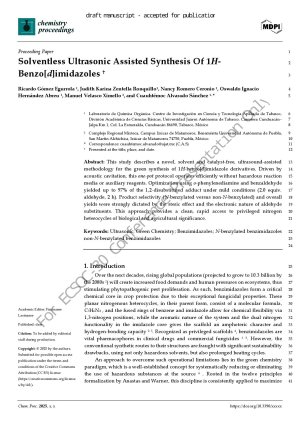
Benzimidazoles are considered privileged structures due to their wide range of reported biological activities. In our aim to obtain benzimidazoles, herein we report a novel methodology to their synthesis. Methodology proceeds solvent free under ultrasonic conditions by the condensation of o-phenylenediamine with several aldehydes.
Experimental part
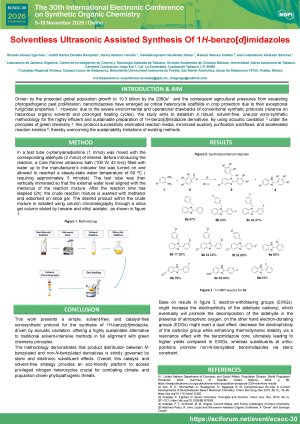
In a test tube o-phenylenediamine is added , followed by the aldehyde of interest. This reaction mixture is allowed to react in a Cole Parmer ultrasonic processor (Input:50-60 Hz), which has a water bath that was already checked to be stable at 60ºC. After the reaction time has elapsed, the reaction crude is washed with methanol. The desired product within the crude mixture is isolated using column chromatography.
Results and Discussion
First, o-phenylenediamine was reacted with benzaldehyde under aqueous conditions giving the desired 1H-benzo[d]imidazole with a 40% yield. Aiming to increase the yield, conditions were changed, and molecular iodine was used to catalyze the reaction under solvent-free and ultrasonic conditions, which resulted in an 80% yield. To maxime the yield, molecular iodine was removed from the reaction, giving a 97% yield. Following this procedure, 10 compounds were synthesized with yields ranging from 17-83%. Compounds with electron-withdrawing groups in both the benzene ring of the aldehyde and the diamine gave the highest yields.
Conclusions
In conclusion, the catalysis-free ultrasonic solventless synthesis of 1-H-benzo[d]imidazoles, by the condensation of o-phenylenediamine with several aldehydes, depends on the chemical substituents and the position of them within the benzene ring of both the aldehyde and the diamine.
Keywords
Ultrasonic
Solvent Free
Green Chemistry
Benzimidazoles
Manuscript
[Sciforum-206737] - [Manuscript PDF] - [Submission accepted].pdf
Poster
[Sciforum-206737] - [Poster] - [Submission accepted].pdf
Lactam functionalized Anthraquinone: A Versatile Recognition scaffold for detection of S2- ions.
Molecular modelling of γ-cyclodextrin inclusion complexes with poorly soluble non-steroidal anti-inflammatory drugs