Event submissions
Published
This submission belongs to the session Session 3. Design and Application of Organic/Supramolecular Assemblies of the event The 30th International Electronic Conference on Synthetic Organic Chemistry
Published date
02 Nov, 2026
Academic Editor
 Julio A. Seijas
Citation
Victoria Andreevna Pavlova, Elena Grekhneva, Molecular modelling of γ-cyclodextrin inclusion complexes with poorly soluble non-steroidal anti-inflammatory drugs, in Proceedings of The 30th International Electronic Conference on Synthetic Organic Chemistry, 5 November–19 November 2026, MDPI: Basel, Switzerland
Share
Email
Facebook
Twitter
LinkedIn
Molecular modelling of γ-cyclodextrin inclusion complexes with poorly soluble non-steroidal anti-inflammatory drugs

Victoria Andreevna Pavlova 1
Elena Grekhneva 1
1. Department of Chemistry, Kursk State University, Kursk, Russia
Abstract
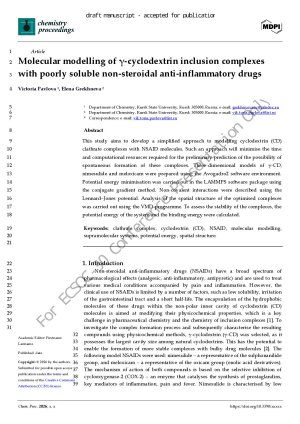
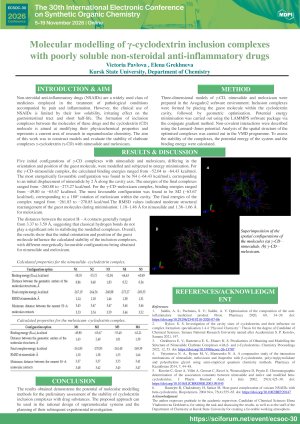
This study aims to develop a simplified approach to modelling cyclodextrin (CD) clathrate complexes with NSAID molecules. Such an approach will minimise the time and computational resources required for the preliminary prediction of the possibility of spontaneous formation of these complexes.
Three-dimensional models of γ-CD, nimesulide and meloxicam were prepared using the Avogadro2 software environment. Potential energy minimisation was carried out in the LAMMPS 64-bit 22Jul2025 software package using the conjugate gradient method. Non-covalent interactions were described using the Lennard–Jones potential. Analysis of the spatial structure of the optimised complexes was carried out using the VMD programme. To assess the stability of the complexes, the potential energy of the system and the binding energy were calculated.
The presented scheme was tested for the calculation of γ-cyclodextrin complexes with nimesulide and meloxicam. Based on the negative values of the potential energy and binding energy obtained, as well as the analysis of the spatial structure, it was concluded that NSAIDs can spontaneously incorporate into the cyclodextrin cavity and that such complexes are stable.
This calculation formed the basis for the experimental synthesis of clathrate complexes of nimesulide and meloxicam. The resulting complexes were subsequently investigated using a range of physicochemical analytical methods.
Keywords
clathrate complex
cyclodextrin (CD)
NSAID
molecular modelling
supramolecular systems
potential energy
spatial structure
Manuscript
[Sciforum-202335] - [Manuscript PDF] - [Submission accepted].pdf
Poster
[Sciforum-202335] - [Poster] - [Submission accepted].pdf
Solventless Ultrasonic Assisted Synthesis Of 1H-Benzo[d]imidazoles
Design and Synthesis of Chromone-based Fluorescent Probes for the Selective Determination of Ni²⁺