Event submissions
Published
This submission belongs to the session Session 3. Design and Application of Organic/Supramolecular Assemblies of the event The 30th International Electronic Conference on Synthetic Organic Chemistry
Published date
02 Nov, 2026
Academic Editor
 Anna Pratima Nikalje
Citation
Naziha OUKEBDANE, Imene HAMZI, Yazid DATOUSSAID, Julio A Seijas, M Pilar Vázquez-Tato, Design and Synthesis of Chromone-based Fluorescent Probes for the Selective Determination of Ni²⁺, in Proceedings of The 30th International Electronic Conference on Synthetic Organic Chemistry, 5 November–19 November 2026, MDPI: Basel, Switzerland
Share
Email
Facebook
Twitter
LinkedIn
Design and Synthesis of Chromone-based Fluorescent Probes for the Selective Determination of Ni²⁺

Naziha OUKEBDANE 1
Imene HAMZI 2
Yazid DATOUSSAID 3

Julio A Seijas 4

M Pilar Vázquez-Tato 4
1. Laboratory of Catalysis and Synthesis in Organic Chemistry, Faculty of Sciences, University of Tlemcen, BP 119, 13000 Tlemcen, Algeria.
2. Department of Pharmacy, Faculty of Medicine, University of Tlemcen, Tlemcen, Algeria
3. Higher School of Applied Sciences of Tlemcen (ESSAT), Tlemcen, Algeria
4. Departamento de Química Orgánica, Facultade de Ciencias, Universidade de Santiago de Compostela, 5
Campus Terra, 27080 Lugo, Spain
Abstract
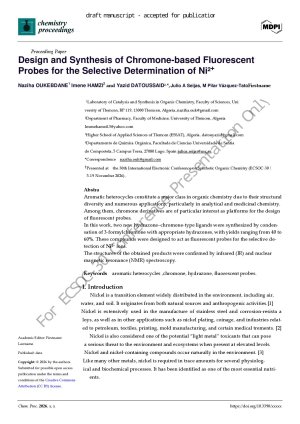
Aromatic heterocycles constitute an essential class of compounds in organic chemistry with broad applications in analytical and medicinal chemistry. Among them, chromone derivatives have emerged as valuable platforms for developing fluorescent and colorimetric probes due to their favorable photophysical properties. Concurrently, detecting transition metals remains a critical environmental and biological challenge. Although nickel is a vital trace element, its excessive accumulation causes toxicity, requiring the development of reliable, rapid, and sensitive detection methods.
In this work, we report the synthesis of novel heterocyclic chemosensors. Two hydrazone-chromone type ligands were successfully prepared through the condensation of 3-formylchromone with substituted hydrazones under mild conditions, yielding 40–60% after purification. These compounds were designed as fluorescent probes for the selective recognition of Ni2+ ions in solution. The proposed sensing mechanism relies on the coordination of the metal center with the oxygen and nitrogen heteroatoms of the ligand. The structures of the synthesized products were fully confirmed using standard spectroscopic techniques, including infrared (IR) and 1H nuclear magnetic resonance (NMR).
The preliminary evaluation indicates that these systems are promising analytical tools for the selective detection of nickel (II), even alongside competing metal ions. This study provides a basis for the further development of practical applications in real-time environmental monitoring and chemical detection.
Keywords
aromatic heterocycles
chromone
hydrazone
fluorescent probes.
Manuscript
[Sciforum-202487] - [Manuscript PDF] - [Submission accepted].pdf
Molecular modelling of γ-cyclodextrin inclusion complexes with poorly soluble non-steroidal anti-inflammatory drugs
Efficient One-Pot Synthesis of Novel 1,4-Disubstituted Triazoles via Click Chemistry under Mild Conditions