Event submissions
EventsMOL2NET'16, Conference on Molecular, Biomed., Comput. & Network Science and Engineering, 2nd ed.
Published

This submission belongs to the session 01. CHEMBIOINFO-02: Chem-Bioinformatics Congress Cambridge, UK-Chapel Hill and Richmond, USA, 2016. of the event MOL2NET'16, Conference on Molecular, Biomed., Comput. & Network Science and Engineering, 2nd ed.
Published date
03 Nov, 2016
Citation
Isabel Fuenzalida-Valdivia, Rodrigo Recabarren, Jans Alzate-Morales, Molecular dynamics analysis of the binding mechanism of veratryl alcohol at the protein surface of lignin peroxidase (P. chrysosporium) and its mutants E168Q and D264N., in Proceedings of MOL2NET'16, Conference on Molecular, Biomed., Comput. & Network Science and Engineering, 2nd ed., 15 October–20 October 2022, MDPI: Basel, Switzerland, doi: 10.3390/mol2net-02-17008
Share
Email
Facebook
Twitter
LinkedIn
Molecular dynamics analysis of the binding mechanism of veratryl alcohol at the protein surface of lignin peroxidase (P. chrysosporium) and its mutants E168Q and D264N.
'%3e%3cpath%20d='M12.6647%2010.9104C12.4176%2010.325%2012.0589%209.7933%2011.6088%209.34485C11.16%208.89511%2010.6283%208.53653%2010.0432%208.28891C10.038%208.28629%2010.0327%208.28498%2010.0275%208.28236C10.8437%207.69282%2011.3743%206.73252%2011.3743%205.64907C11.3743%203.85423%209.92005%202.40002%208.12522%202.40002C6.33038%202.40002%204.87618%203.85423%204.87618%205.64907C4.87618%206.73252%205.40677%207.69282%206.22296%208.28367C6.21772%208.28629%206.21248%208.2876%206.20724%208.29022C5.62031%208.53783%205.09365%208.89287%204.64167%209.34616C4.19192%209.79496%203.83334%2010.3266%203.58573%2010.9117C3.34247%2011.4846%203.21128%2012.0987%203.19925%2012.721C3.1989%2012.735%203.20135%2012.7489%203.20646%2012.7619C3.21157%2012.7749%203.21924%2012.7868%203.22901%2012.7968C3.23877%2012.8068%203.25045%2012.8148%203.26334%2012.8202C3.27623%2012.8256%203.29007%2012.8284%203.30406%2012.8284H4.09012C4.14776%2012.8284%204.19362%2012.7825%204.19493%2012.7262C4.22113%2011.7148%204.62726%2010.7676%205.34519%2010.0497C6.08802%209.30686%207.07452%208.89811%208.12522%208.89811C9.17592%208.89811%2010.1624%209.30686%2010.9052%2010.0497C11.6232%2010.7676%2012.0293%2011.7148%2012.0555%2012.7262C12.0568%2012.7839%2012.1027%2012.8284%2012.1603%2012.8284H12.9464C12.9604%2012.8284%2012.9742%2012.8256%2012.9871%2012.8202C13%2012.8148%2013.0117%2012.8068%2013.0214%2012.7968C13.0312%2012.7868%2013.0389%2012.7749%2013.044%2012.7619C13.0491%2012.7489%2013.0515%2012.735%2013.0512%2012.721C13.0381%2012.0947%2012.9084%2011.4856%2012.6647%2010.9104ZM8.12522%207.90243C7.52388%207.90243%206.95792%207.66793%206.53214%207.24215C6.10636%206.81636%205.87185%206.2504%205.87185%205.64907C5.87185%205.04773%206.10636%204.48177%206.53214%204.05599C6.95792%203.63021%207.52388%203.3957%208.12522%203.3957C8.72655%203.3957%209.29252%203.63021%209.7183%204.05599C10.1441%204.48177%2010.3786%205.04773%2010.3786%205.64907C10.3786%206.2504%2010.1441%206.81636%209.7183%207.24215C9.29252%207.66793%208.72655%207.90243%208.12522%207.90243Z'%20fill='%235D1EE1'/%3e%3c/g%3e%3c/svg%3e)
Isabel Fuenzalida-Valdivia 1
Rodrigo Recabarren 1
Jans Alzate-Morales 1
1. Centro de Bioinformática y Simulación Molecular, Facultad de Ingeniería, Universidad de Talca, 2 Norte 685, Casilla 721, Talca, Chile.
Abstract
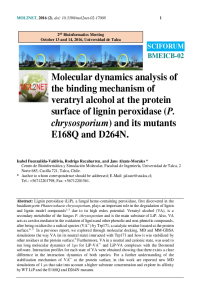
Lignin peroxidase (LiP), a fungal heme-containing peroxidase, first discovered in the basidiomycete Phanerochaete chrysosporium, plays an important role in the degradation of lignin and lignin model compounds1-3 due to its high redox potential. Veratryl alcohol (VA), is a secondary metabolite of the fungus P. chrysosporium and is the main substrate of LiP. Also, VA acts as a redox mediator in the oxidation of lignin and other phenolic and non-phenolic compounds, after being oxidized to a radical species (VA•+) by Trp171, a catalytic residue located at the protein surface.4, 5 In a previous report, we explored through molecular docking, MD and MM-GBSA simulations the way VA (in its neutral state) interacted with Trp171 and how it was stabilized by other residues at the protein surface.6 Furthermore, VA in a neutral and cationic state, was used to run long molecular dynamics of 1µs for LiP-VA•+ and LiP-VA complexes with the Desmond software. Interaction profiles for each state of VA were obtained showing that there exists a clear difference in the interaction dynamics of both species. For a further understanding of the stabilization mechanism of VA•+ at the protein surface, in this work are reported new MD simulations of 1 µs that take into account a higher substrate concentration and explore its affinity by WT LiP and the E168Q and D264N mutants.
Keywords
Poster
f08_BMEICB-02_2016_IsabelFuenzalida.pdf
Software for the topological analysis of the Fukui function (TAFF).
A first aproximation for prediction of bloom phenology of Quillaja saponaria (quillay), a Chilean native species of beekeeping interest.