Event submissions
Published
This submission belongs to the session Session 1. General Organic Synthesis of the event The 30th International Electronic Conference on Synthetic Organic Chemistry
Published date
02 Nov, 2026
Academic Editor
 Julio A. Seijas
Citation
Xufeng Zhang, Han Li, Reliable Yield Modeling for 2-Arylbenzimidazole Synthesis: Source Bias, Endpoint Definition, and Validation Boundaries, in Proceedings of The 30th International Electronic Conference on Synthetic Organic Chemistry, 5 November–19 November 2026, MDPI: Basel, Switzerland
Share
Email
Facebook
Twitter
LinkedIn
Reliable Yield Modeling for 2-Arylbenzimidazole Synthesis: Source Bias, Endpoint Definition, and Validation Boundaries

Xufeng Zhang 1
Han Li 1
1. Resp AI Research Lab, Xiamen, 361000, CIIOE, China
Abstract
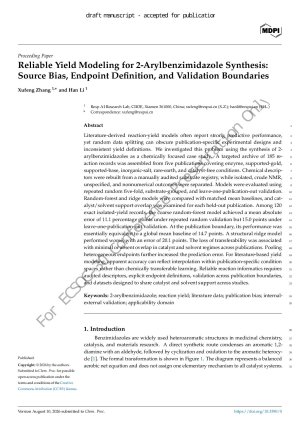
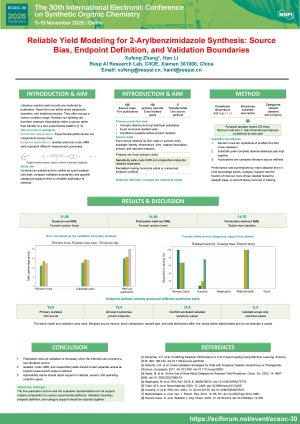
Introduction: Literature-derived reaction-yield models often report strong predictive performance, yet random data splitting can obscure publication-specific experimental designs and inconsistent yield definitions. We investigated this problem using the synthesis of 2-arylbenzimidazoles as a chemically focused case study.
Methods: A targeted archive of 185 reaction records was assembled from five publications covering enzyme, supported-gold, supported-base, inorganic-salt, rare-earth, and catalyst-free conditions. Chemical descriptors were rebuilt from a manually audited substrate registry, while isolated, crude NMR, unspecified, and nonnumerical outcomes were separated. Models were evaluated using repeated random five-fold, substrate-grouped, and leave-one-publication-out validation. Random-forest and ridge models were compared with matched mean baselines, and catalyst/solvent support overlap was examined for each held-out publication.
Results: Among 120 exact isolated-yield records, the coarse random-forest model achieved a mean absolute error of 11.1 percentage points under repeated random validation but 15.0 points under leave-one-publication-out validation. At the publication boundary, its performance was essentially equivalent to a global mean baseline of 14.7 points. A structural ridge model performed worse, with an error of 20.1 points. The loss of transferability was associated with minimal or absent overlap in catalyst and solvent regimes across publications. Pooling heterogeneous endpoints further increased the prediction error.
Conclusions: For literature-based yield modeling, apparent accuracy can reflect interpolation within publication-specific condition spaces rather than chemically transferable learning. Reliable reaction informatics requires audited descriptors, explicit endpoint definitions, validation across publication boundaries, and datasets designed to share catalyst and solvent support across studies.
Keywords
2-arylbenzimidazole
reaction informatics
yield prediction
source bias
cross-publication validation
Manuscript
[Sciforum-207659] - [Manuscript PDF] - [Submission accepted].pdf
Poster
ECSOC2026poster.pdf
Efficient One-Pot Synthesis of Novel 1,4-Disubstituted Triazoles via Click Chemistry under Mild Conditions
Synthesis and Electropolymerization of a Naphthalene Diimide derivative Dicarbazole-Functionalized NDI-2CBZ. n-p Dopable Electropolymer with Electrochromic and Supercapacitive Properties.