Event submissions
Published
This submission belongs to the session Session 2. Chemistry of Bioorganics, Medicinal and Natural Products of the event The 30th International Electronic Conference on Synthetic Organic Chemistry
Published date
02 Nov, 2026
Academic Editor
 Julio A. Seijas
Citation
Aicha laoud, Abderahmane Belafriekh, In Silico Design of Novel Sulfonamide Derivatives as Hepatitis B Virus Polymerase Inhibitors Using Molecular Docking, 3D-QSAR, and ADMET Analysis, in Proceedings of The 30th International Electronic Conference on Synthetic Organic Chemistry, 5 November–19 November 2026, MDPI: Basel, Switzerland
Share
Email
Facebook
Twitter
LinkedIn
In Silico Design of Novel Sulfonamide Derivatives as Hepatitis B Virus Polymerase Inhibitors Using Molecular Docking, 3D-QSAR, and ADMET Analysis

Aicha laoud 1
Abderahmane Belafriekh 2
1. Department of Chemical Engineering, Faculty of Chemical Engineering, University of Salah Boubnider Constantine 3, Constantine 25000, Algeria.
2. Laboratory of LCPMM, Chemistry Department, Faculty of Sciences, University of Blida 1, P.O. Box 270 Blida, 09000, Algeria.
Abstract
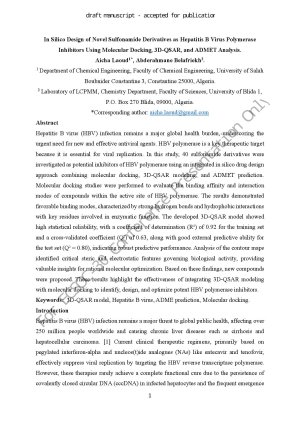
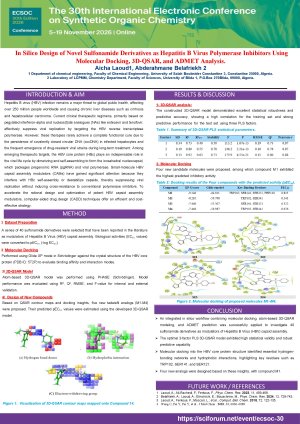
Hepatitis B virus (HBV) infection remains a major global health burden, underscoring the urgent need for new and effective antiviral agents. HBV polymerase is a key therapeutic target because it is essential for viral replication. In this study, 40 sulfonamide derivatives were investigated as potential inhibitors of HBV polymerase using an integrated in silico drug design approach combining molecular docking, 3D-QSAR modeling, and ADMET prediction. Molecular docking studies were performed to evaluate the binding affinity and interaction modes of compounds within the active site of HBV polymerase. The results demonstrated favorable binding modes, characterized by strong hydrogen bonds and hydrophobic interactions with key residues involved in enzymatic function. The developed 3D-QSAR model showed high statistical reliability, with a coefficient of determination (R²) of 0.92 for the training set and a cross-validated coefficient (Q²) of 0.63, along with good external predictive ability for the test set (Q² = 0.80), indicating robust predictive performance. Analysis of the contour maps identified critical steric and electrostatic features governing biological activity, providing valuable insights for rational molecular optimization. Based on these findings, ten new compounds were proposed. These results highlight the effectiveness of integrating 3D-QSAR modeling with molecular docking to identify, design, and optimize potent HBV polymerase inhibitors.
Keywords
sulfonamides
QSAR
HBV
Docking
ADMET
Manuscript
[Sciforum-182157] - [Manuscript PDF] - [Submission accepted].pdf
Poster
Poster- Aicha Laoud.pdf
Influence of the spatial configuration of 2-(2,4-dioxopyrimidin-1-yl)-5-hydroxymethyl-5-(trifluoromethyl)tetrahydrothiophene stereoisomers on their antiherpetic activity
A Rhodamine–Phenothiazine-Based Dual Colorimetric and Fluorometric Probe for Highly Selective Detection of Hg²⁺ Ions