Event submissions
Published
This submission belongs to the session Session 2. Chemistry of Bioorganics, Medicinal and Natural Products of the event The 30th International Electronic Conference on Synthetic Organic Chemistry
Published date
02 Nov, 2026
Academic Editor
 Julio A. Seijas
Citation
TAMARA FUKALOVA FUKALOVA, JEFFERSON SALTO LEMA, Ivan Tapia Calvopiña, Juan Romero Lastra, Ecuadorian Rosemary (Salvia rosmarinus L.): Comparison of Soil, Proximate Composition, and Bioactive Compounds between Wild and Urban Systems, in Proceedings of The 30th International Electronic Conference on Synthetic Organic Chemistry, 5 November–19 November 2026, MDPI: Basel, Switzerland
Share
Email
Facebook
Twitter
LinkedIn
Ecuadorian Rosemary (Salvia rosmarinus L.): Comparison of Soil, Proximate Composition, and Bioactive Compounds between Wild and Urban Systems

TAMARA FUKALOVA FUKALOVA 1
JEFFERSON SALTO LEMA 1
Ivan Tapia Calvopiña 1
Juan Romero Lastra 2
1. Facultad de Ciencias Químicas. Grupos de investigación ACMME y GIDESTUR. Universidad Central del Ecuador, Quito, Ecuador
2. Facultad de Ciencias Químicas. Grupo de investigación MoleMater. Universidad Central del Ecuador, Qui-to, Ecuador
Abstract
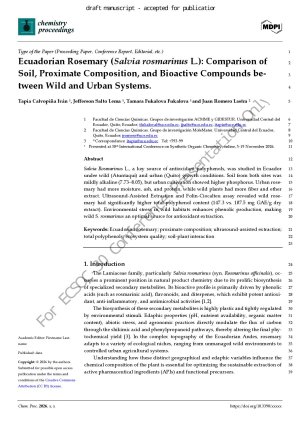
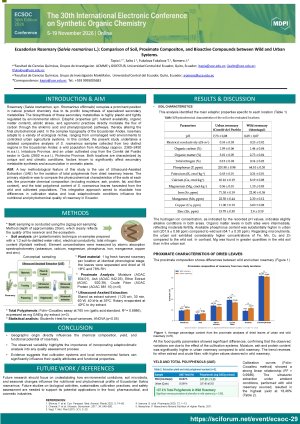
Rosemary (Salvia Rosmarinus L.) is an aromatic and medicinal plant widely used due to its content of bioactive phenolic compounds with potent antioxidant properties. Edaphic and environmental factors significantly influence the secondary metabolism and nutritional quality of medicinal plants. The objective of this study was to compare the physicochemical characteristics of the soil, the proximate composition, and the total polyphenol content in dried leaves of wild rosemary from Atuntaqui (Imbabura) and cultivated rosemary from the Comité del Pueblo sector in Quito (Pichincha), two locations in the Ecuadorian Andes.
Physicochemical analyses of the soil were performed (pH, electrical conductivity, organic matter, macronutrients, and micronutrients). The plant material was subjected to proximate analysis (moisture, ash, ether extract, crude fiber, protein, and total carbohydrates by difference). Additionally, the total polyphenol content was quantified using the Folin-Ciocalteu spectrophotometric method, expressed as mg gallic acid equivalents (GAE)/g of dry extract.
Significant differences were observed between both types of rosemary. Wild rosemary showed higher values of ether extract (14.12 ± 0.13%), crude fiber (19.47%), and notably higher total polyphenol content (147.30 ± 5.35 mg GAE/g) compared to cultivated rosemary (107.46 ± 5.63 mg GAE/g). Cultivated samples presented higher protein content (11.73 ± 0.15%). These results indicate that wild growing conditions under moderate stress in the Andean environment favor a greater biosynthesis of phenolic compounds, thereby increasing the antioxidant potential.
This study provides relevant local information that contributes to the valorization of rosemary as a source of natural antioxidants for the food, pharmaceutical, and nutraceutical industries.
Keywords
Salvia rosmarinus
rosemary
wild vs cultivated
proximate analysis
total polyphenols
Folin-Ciocalteu
Ecuadorian Andes
antioxidant activity.
Manuscript
[Sciforum-189132] - [Manuscript PDF] - [Submission accepted].pdf
Poster
189132.pdf
A Rhodamine–Phenothiazine-Based Dual Colorimetric and Fluorometric Probe for Highly Selective Detection of Hg²⁺ Ions
Versatile manganese porphyrin, capable of detecting iodide anions by spectrophotometric and electrochemical methods