Event submissions
Published
This submission belongs to the session Session 2. Chemistry of Bioorganics, Medicinal and Natural Products of the event The 30th International Electronic Conference on Synthetic Organic Chemistry
Published date
02 Nov, 2026
Academic Editor
 Julio A. Seijas
Citation
Gulnara Shakirzyanova, Omankul Xolbekov, Ulugbek Togaev, Alimjon Alim Matchаnov, Study of bioinsecticidal activity of linalool derivative., in Proceedings of The 30th International Electronic Conference on Synthetic Organic Chemistry, 5 November–19 November 2026, MDPI: Basel, Switzerland
Share
Email
Facebook
Twitter
LinkedIn
Study of bioinsecticidal activity of linalool derivative.

Gulnara Shakirzyanova 1
Omankul Xolbekov 1
Ulugbek Togaev 1
Alimjon Alim Matchаnov 1
1. Institute of Bioorganic Chemistry Uzbek Academy of Scienses, Mirzo Ulugbek street, 83, 100125 Tashkent, Uzbekistan
Abstract
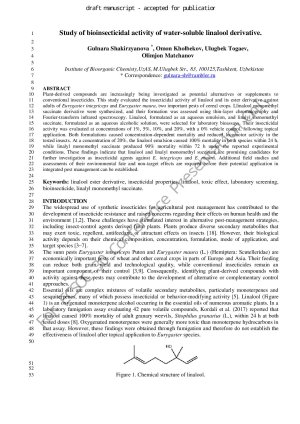
The aim of this study was to evaluate the insecticidal properties of a linalool derivative against Eurygaster integriceps and Eurygaster maura, the main pest insects of cereal crops. We investigated the insecticidal properties of a linalool derivative as an analog of a synthetic plant-based insecticide.
Plants such as Coriandrum sativum L., Apiaceae, Juniperus, and Artemisia annua are rich sources of compounds with insecticidal activity. Plants accumulate various metabolites that can play a protective role against pest insects and other plant-feeding organisms.
Linalool, a plant-derived monoterpene alcohol, is a promising compound with a variety of uses. Linalool indicating its potential usage in the control of pathogens and growing pest insects has proven antimicrobial and insecticidal properties.
Linalool was isolated from Coriandrum sativum L., Apiaceae seeds, modified into linalyl monomethyl succinate. In conditions of Coriandrum sativum L., Apiaceae hydrodistillation, an essential oil were yielded with a high up to 75% consisting of linalool. After we obtained a derivative of linalool as linalyl monomethyl succinate.
Modified linalool, as linalyl monomethyl succinate, tested for contact toxicity on insects of Eurygaster integriceps and Eurygaster maura. An aqueous solution of linalyl monomethyl succinate caused effective and rapid 100% mortality in insects within the first three days of the test period when applied topically. The testing linalyl monomethyl succinate solution possessed toxic properties and altered insect behavior to varying degrees, depending on its concentration.
Our experiments of plant-based compound insecto-toxicity are ongoing.
Keywords
Linalool
insecticidal properties
linalyl monomethyl succinate
insects
mortality
Manuscript
[Sciforum-197340] - [Manuscript PDF] - [Submission accepted].pdf
Explainable Artificial Intelligence-Guided Virtual Screening of Supramolecular Organic Assemblies for Multi-Target Alzheimer’s Disease Therapy
Anti-angiogenesis and molecular simulation of new diarylpentanoid analogue as TLR4/MD2 antagonist.