Event submissions
Published
This submission belongs to the session Session 4. Physical Organic Chemistry of the event The 30th International Electronic Conference on Synthetic Organic Chemistry
Published date
02 Nov, 2026
Academic Editor
 Julio A. Seijas
Citation
DARSSHEN RAMANA KATHIRASAN, Seow Lay Jing, Norul Aini Zakariya, Nuha Binti Muhammad Zaki, Khor Poh Yen, Anti-angiogenesis and molecular simulation of new diarylpentanoid analogue as TLR4/MD2 antagonist., in Proceedings of The 30th International Electronic Conference on Synthetic Organic Chemistry, 5 November–19 November 2026, MDPI: Basel, Switzerland
Share
Email
Facebook
Twitter
LinkedIn
Anti-angiogenesis and molecular simulation of new diarylpentanoid analogue as TLR4/MD2 antagonist.

DARSSHEN RAMANA KATHIRASAN 1,2
Seow Lay Jing 1
Norul Aini Zakariya 1
Nuha Binti Muhammad Zaki 1
Khor Poh Yen 1
1. Faculty Pharmacy and Health Sciences, Royal College of Medicine Perak, Universiti Kuala Lumpur, 30450 Ipoh, Perak, Malaysia
2. Pharmacy Department, Hospital Raja Permaisuri Bainun, Jalan Raja Ashman Shah, 30450 Ipoh, Perak, Malaysia
Abstract
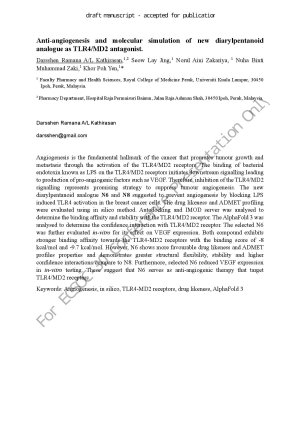
Introduction: Angiogenesis defined as the growth of the new blood vessels from existing vessels. Angiogenesis is the fundamental hallmark of the cancer crucial for both tumour growth and metastasis through the activation of the TLR4/MD2 receptors. Angiogenesis is caused by the binding of bacterial endotoxin known as LPS on the TLR4/MD2 receptors that triggers the downstream signalling that induce in the production of pro-angiogenic factors such as VEGF. The inhibition of the TLR4/MD2 signalling serves as a promising strategy to prevent the angiogenesis by reducing the tumour growth and metastasis. The new diarylpentanoid analogue N6 and N8 has the tendency to prevent angiogenesis by blocking LPS induced TLR4 activation in the breast cancer cells. Methods: The drug likeness and ADMET profiling was evaluated using in silico method. Autodocking and IMOD server was analyse to determine the binding affinity and stability of the N6 and N8 towards the TLR4 receptor. The AlphaFold 3 was analysed to determine the confidence interaction of the N6 and N8 with TLR4/MD2 receptor. Results: Both N6 and N8 compound exhibits stronger binding affinity towards the TLR4-MD2 receptors with the binding score of -8 kcal/mol and -9.7 kcal/mol. The dynamic stability shows that N6 is more stable and flexible with the MD2 receptors. N6 shows higher confidence interactions compare to N8 based on AlphaFold 3 analysis. In addition, N6 shows favourable drug likeness and ADMET properties compare to N8. Conclusion: The new diarylpentanoid analogue, N6 shows its potential as strong antiangiogenic drugs.
Keywords
Angiogenesis
in silico
TLR4-MD2 receptors
drug likeness
AlphaFold 3
Manuscript
[Sciforum-197332] - [Manuscript PDF] - [Submission accepted].pdf
Study of bioinsecticidal activity of linalool derivative.
Solid-State and Solution-State Characterization of Recrystallized Tetrahydrocurcumin from Ethyl Acetate/Hexane: Crystal Packing and Keto-Enol Equilibrium