Event submissions
Published
This submission belongs to the session Session 2. Chemistry of Bioorganics, Medicinal and Natural Products of the event The 30th International Electronic Conference on Synthetic Organic Chemistry
Published date
02 Nov, 2026
Academic Editor
 Manik Ghosh
Citation
Ikram BABA-AHMED, Zahira KIBOU, Nadia AISSAOUI, Mohammed AISSAOUI, Noureddine CHOUKCHOU-BRAHAM, Julio A. SEIJAS, Antimicrobial and Antioxidant Evaluation of 2-Aminopyridine Derivatives: Bactericidal, Fungicidal, and Radical Scavenging Activities, in Proceedings of The 30th International Electronic Conference on Synthetic Organic Chemistry, 5 November–19 November 2026, MDPI: Basel, Switzerland
Share
Email
Facebook
Twitter
LinkedIn
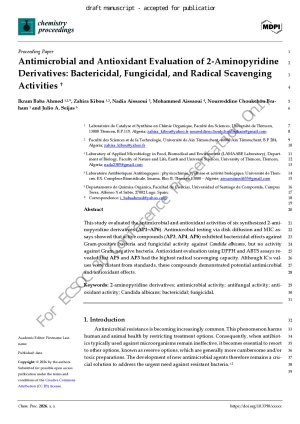
Antimicrobial and Antioxidant Evaluation of 2-Aminopyridine Derivatives: Bactericidal, Fungicidal, and Radical Scavenging Activities

Ikram BABA-AHMED 1,2
Zahira KIBOU 3,4

Nadia AISSAOUI 5
Mohammed AISSAOUI 6
Noureddine CHOUKCHOU-BRAHAM 4

Julio A. SEIJAS 7
1. Faculté des Sciences et de la Technologie, Université de Ain Témouchent, 46000 Ain Témouchent, B.P 284, Algeria
2. Laboratoire de Catalyse et Synthèse en Chimie Organique, Faculté des Sciences, Université de Tlemcen, 13000 Tlemcen, B.P.119, Algeria
3. University Belhadj Bouchaib de AinTémouchent,
B.P 284, 46000 Ain Témouchent, Algeria
4. Laboratoire de Catalyse et Synthèse en Chimie Organique, Faculté des Sciences, Université de Tlemcen,
B.P.119, 13000 Tlemcen, Algeria
5. Laboratory of Applied Microbiology in Food, Biomedical and Environment (LAMAABE Laboratory), Department of Biology, Faculty of Nature and Life, Earth and Universe Sciences, University of Tlemcen, Tlemcen, Algeria
6. Laboratoire Antibiotiques Antifongiques : physicochimie, synthèse et activité biologique. Université de Tlemcen. EX. Complexe Biomédicale, Imama. Bloc B, Tlemcen 13000 – Algeria
7. Departamento de Química Orgánica, Facultad de Ciencias, Universidad of Santiago De Compostela, Alfonso X el Sabio, Lugo 27002, Spain
Abstract
Pyridine-containing molecules are important heterocyclic frameworks in biologically active natural products. This study evaluated the antimicrobial (antibacterial, antifungal) and antioxidant activities of synthesized 2-aminopyridine derivatives, focusing on their action against Gram-negative and Gram-positive bacteria, yeasts, and their radical scavenging capacity.
Antimicrobial activity was assessed using the disk diffusion method on Muller-Hinton Agar for bacteria and Sabouraud Dextrose Agar for yeasts. Gentamicin (10 µg) and Amphotericin B (0.2 mg) served as positive controls. Minimum Inhibitory Concentrations (MIC) were determined via broth microdilution, and MBC/MIC ratios evaluated bactericidal/fungicidal effects. Antioxidant activity was assessed using DPPH and ABTS radical scavenging assays. BHA and BHT served as references (0.002–0.1 mg/mL).
Disk diffusion showed inhibition zones of derivatives were significantly smaller than controls. Among the six tested 2-aminopyridine derivatives (AP1 to AP6), the active compounds (AP3, AP4, AP6) showed activity only against Gram-positive bacteria and C. albicans; no Gram-negative activity was observed. AP6 showed the best antibacterial activity against S. aureus (11.33±0.33 mm). AP4 and AP6 showed the best antifungal activity against C. albicans strains (13.66±0.33 mm each). MBC/MIC values indicated bactericidal and fungicidal effects. For antioxidant activity, AP5 showed the best DPPH reduction (IC50 = 246.65±2.08 µg/mL), followed by AP3 (451.81±9.32 µg/mL). In ABTS assays, IC50 values followed AP3 < AP5 (20.36±3.28, 32.41±2.29 µg/mL, respectively). ABTS assays revealed higher antioxidant activity for AP3 and AP5 compared to DPPH.
The tested compounds demonstrated bactericidal activity against Gram-positive bacteria and fungicidal activity, and showed promising antioxidant potential, though IC50 values remained distant from standards.
Keywords
2-aminopyridine derivatives
antibacterial
antifungal
antioxidant activities.
Manuscript
[Sciforum-198408] - [Manuscript PDF] - [Submission accepted].pdf
Solid-State and Solution-State Characterization of Recrystallized Tetrahydrocurcumin from Ethyl Acetate/Hexane: Crystal Packing and Keto-Enol Equilibrium
Molecular Dynamics Insights into the Recognition of Histone Crotonylation by the AF9 YEATS Domain