Event submissions
Published
This submission belongs to the session Session 4. Physical Organic Chemistry of the event The 30th International Electronic Conference on Synthetic Organic Chemistry
Published date
02 Nov, 2026
Academic Editor
 Julio A. Seijas
Citation
Salma A. Abdelatif, Sahar Elmolla, M. A. Ahmed, Hala R. Mahmoud, Preparation of cheap nano-silica from rice straw for environmental applications, in Proceedings of The 30th International Electronic Conference on Synthetic Organic Chemistry, 5 November–19 November 2026, MDPI: Basel, Switzerland
Share
Email
Facebook
Twitter
LinkedIn
Preparation of cheap nano-silica from rice straw for environmental applications

Salma A. Abdelatif 1
Sahar Elmolla 1
M. A. Ahmed 2
Hala R. Mahmoud 1
1. Chemistry department, Faculty of Education, Ain Shams University, Roxy 11711, Cairo, Egypt
2. Chemistry Department, Faculty of Science, Ain Shams University, Cairo, Egypt
Abstract
Abstract
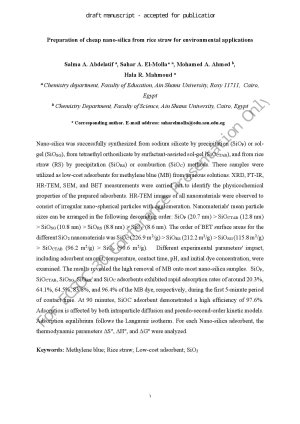
Nano-silica was successfully synthesized from sodium silicate by precipitation (SiOP) or sol-gel (SiOSG), from tetraethyl orthosilicate by surfactant-assisted sol-gel (SiOCTAB), and from rice straw (RS) by precipitation (SiORS) or combustion (SiOC) methods. These samples were utilized as low-cost and methylene blue (MB) adsorbents from aqueous solutions. XRD, FT-IR, HR-TEM, SEM, and BET measurements were carried out to identify the physicochemical properties of the prepared adsorbents. HR-TEM images of all nanomaterials were observed to consist of irregular nano-spherical particles with agglomeration. Nanomaterials' mean particle sizes can be arranged in the following descending order: SiOP (20.7 nm) > SiOCTAB (12.8 nm) > SiOSG (10.8 nm) > SiORS (8.8 nm) > SiOC (8.6 nm). The order of BET surface areas for the different SiO2 nanomaterials was SiOC (226.9 m2/g) > SiORS (212.2 m2/g) > SiOSG (115.8 m2/g) > SiOCTAB (96.2 m2/g) > SiOp (90.6 m2/g). Different experimental parameters' impact, including adsorbent amount, temperature, contact time, pH, and initial dye concentration, were examined. The results revealed high removal of MB onto most Nano-silica samples. SiOP, SiOCTAB, SiOSG, SiORS, and SiOC adsorbents exhibited rapid adsorption rates of around 20.3%, 64.1%, 64.5%, 83.8%, and 96.4% of the MB dye, respectively, during the first 5-minute period of contact time. At 90 minutes, SiOC adsorbent demonstrated a high efficiency of 97.6%. Adsorption is affected by both intraparticle diffusion and pseudo-second-order kinetic models. Adsorption equilibrium follows the Langmuir isotherm. For each Nano-silica adsorbent, the thermodynamic parameters ΔSo, ΔHo, and ΔGo were analyzed.
Keywords
Methylene blue
Rice straw
Low-cost adsorbent
SiO2
Manuscript
[Sciforum-202346] - [Manuscript PDF] - [Submission accepted].pdf
Molecular Dynamics Insights into the Recognition of Histone Crotonylation by the AF9 YEATS Domain
Computational and Theoretical Characterization of Novel NSAID Candidates Based on Cyclooxygenase and Lipoxygenase Inhibition