Event submissions
Published
This submission belongs to the session Session 4. Physical Organic Chemistry of the event The 30th International Electronic Conference on Synthetic Organic Chemistry
Published date
02 Nov, 2026
Academic Editor
 Anna Pratima Nikalje
Citation
Julio A. Seijas, M. Pilar Vázquez-Tato, DFT study of the redox behavior of cyameluric acid trimethylamide for energy storage applications, in Proceedings of The 30th International Electronic Conference on Synthetic Organic Chemistry, 5 November–19 November 2026, MDPI: Basel, Switzerland
Share
Email
Facebook
Twitter
LinkedIn
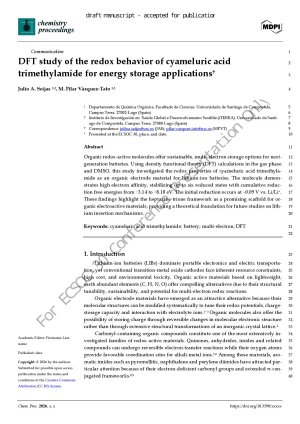
DFT study of the redox behavior of cyameluric acid trimethylamide for energy storage applications

Julio A. Seijas 1,2

M. Pilar Vázquez-Tato 1
1. Departamento de Química Orgánica. Facultade de Ciencias. Universidade de Santiago de Compostela. Campus Terra. 27080-Lugo. Spain
2. Instituto de Investigación en ´Saúde Global e Desenvolvemento Sostible (iTERRA). Universidade de Santiago de Compostela. Campus Terra. 27080-Lugo. Spain
Abstract
Organic redox-active molecules have emerged as attractive building blocks for next-generation electrochemical energy storage because of their structural tunability, low environmental impact, and potential for multi-electron charge storage. In this work, the redox properties of cyameluric acid trimethylamide (1,3,4,6,7,9,9b-heptaazaphenalene-2,5,8(1H,4H,7H)-trione, 1,4,7-trimethyl) were investigated using density functional theory (DFT) calculations to assess its suitability as a molecular platform for the design of organic electrode materials for lithium-ion batteries. Geometry optimizations and free-energy calculations were performed in both the gas phase and DMSO solution to determine the thermodynamics of successive electron uptake and the corresponding redox potentials referenced to the Li/Li⁺ electrode. The molecule exhibits a high electron affinity and can stabilize multiple reduced states, with cumulative reduction free energies of −3.14, −5.40, −6.51, −7.78, −7.87, and −8.10 eV for the incorporation of one to six electrons, respectively. The first reduction process occurs at approximately 0.09 V versus Li/Li⁺, while subsequent reductions become progressively less favorable because of the increasing Coulombic repulsion associated with highly charged molecular species. The predicted ability to accommodate multiple stable redox states highlights the intrinsic electron-accepting capability of the heptazine-trione framework and suggests that it represents a promising molecular scaffold for the development of organic electroactive materials. These preliminary results provide a theoretical basis for future studies on lithiated derivatives, lithium coordination, crystal packing, and lithium insertion mechanisms to evaluate the feasibility of incorporating this molecular framework into practical organic electrode materials for rechargeable lithium-ion batteries.
Keywords
cyameluric acid trimethylamide
battery
DFT
Materials
redox
Manuscript
[Sciforum-204150] - [Manuscript PDF] - [Submission accepted].pdf
Computational and Theoretical Characterization of Novel NSAID Candidates Based on Cyclooxygenase and Lipoxygenase Inhibition
Lignin Valorisation: Synthesis of Compounds and Applications in Environmental Engineering