Event submissions
Published
This submission belongs to the session Session 2. Chemistry of Bioorganics, Medicinal and Natural Products of the event The 30th International Electronic Conference on Synthetic Organic Chemistry
Published date
02 Nov, 2026
Academic Editor
 Julio A. Seijas
Citation
Gustavo Adolfo Gutiérrez-Peña, Zaira Valeria Barrientos-Rico, Jaime Juan Huerta-Delgado, Luis E. Cárdenas-Galindo, Pedro A. Cano, Lignin Valorisation: Synthesis of Compounds and Applications in Environmental Engineering, in Proceedings of The 30th International Electronic Conference on Synthetic Organic Chemistry, 5 November–19 November 2026, MDPI: Basel, Switzerland
Share
Email
Facebook
Twitter
LinkedIn
Lignin Valorisation: Synthesis of Compounds and Applications in Environmental Engineering

Gustavo Adolfo Gutiérrez-Peña 1
Zaira Valeria Barrientos-Rico 1
Jaime Juan Huerta-Delgado 1
Luis E. Cárdenas-Galindo 2

Pedro A. Cano 1
1. Departamento de Ingenierías Civil y Ambiental, División de Ingenierías, Universidad de Guanajuato, Avenida Juárez #77, Zona Centro, CP: 36000, Guanajuato, Gto. México
2. Departamento de Química. Universidad Tecnológica de Salamanca. Avenida Universidad Tecnológica No. 200 Col. Ciudad bajío CP. 36766 Salamanca, Gto., México
Abstract
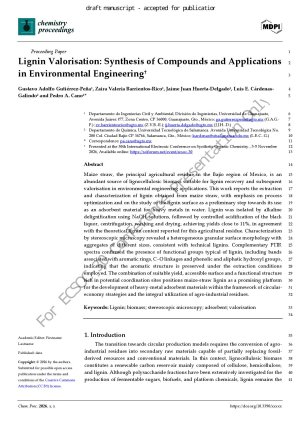
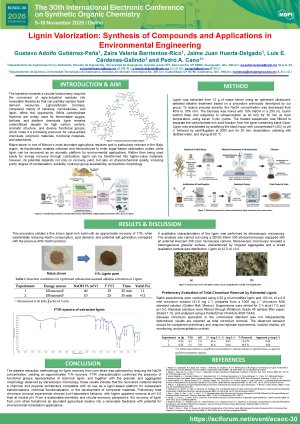
Maize straw, the principal agricultural residue in the Bajío region of Mexico, is an abundant source of lignocellulosic biomass suitable for lignin recovery and subsequent valorisation in environmental engineering applications. This work reports the extraction and characterisation of lignin obtained from maize straw, with emphasis on process optimisation and on the study of the lignin surface as a preliminary step towards its use as an adsorbent material for heavy metals in water. Lignin was isolated by alkaline delignification using NaOH solutions, followed by controlled acidification of the black liquor, centrifugation, washing and drying, achieving yields close to 11%, in agreement with the theoretical lignin content reported for this agricultural residue. Characterisation by stereoscopic microscopy revealed a heterogeneous granular surface morphology with aggregates of different sizes, consistent with technical lignins. Complementary FTIR spectra confirmed the presence of functional groups typical of lignin, including bands associated with aromatic rings, C–O linkages and phenolic and aliphatic hydroxyl groups, indicating that the aromatic structure is preserved under the extraction conditions employed. The combination of suitable yield, accessible surface and a functional structure rich in potential coordination sites positions maize-straw lignin as a promising platform for the development of heavy-metal adsorbent materials within the framework of circular-economy strategies and the integral utilisation of agro-industrial residues.
Keywords
Lignin
biomass
stereoscopic microscopy
adsorbent
valorisation
Manuscript
[Sciforum-200446] - [Manuscript PDF] - [Submission accepted].pdf
Poster
[Sciforum-200446] - [Poster] - [Submission accepted].pdf
DFT study of the redox behavior of cyameluric acid trimethylamide for energy storage applications
Adsorption of Thorium(IV) from Aqueous Solutions Using Magnetic Casuarina equisetifolia Needles