Event submissions
Published
This submission belongs to the session Session 4. Physical Organic Chemistry of the event The 30th International Electronic Conference on Synthetic Organic Chemistry
Published date
02 Nov, 2026
Academic Editor
 Julio A. Seijas
Contribution&Funding
Writing - original draft,
[ibtissam aissaoui]
Supervision,
[Khalil OUKEBDANE]
Funding: --
Citation
ibtissam aissaoui, Khalil OUKEBDANE, Souad FEDDANE, Yasmine Benmansour, Adsorption of Thorium(IV) from Aqueous Solutions Using Magnetic Casuarina equisetifolia Needles, in Proceedings of The 30th International Electronic Conference on Synthetic Organic Chemistry, 5 November–19 November 2026, MDPI: Basel, Switzerland
Share
Email
Facebook
Twitter
LinkedIn
Adsorption of Thorium(IV) from Aqueous Solutions Using Magnetic Casuarina equisetifolia Needles

ibtissam aissaoui 1
Khalil OUKEBDANE 1
Souad FEDDANE 1
Yasmine Benmansour 1
1. Department of Chemistry, Abou Bekr Belkaid University of Tlemcen, Tlemcen, 13000, Algeria
Abstract
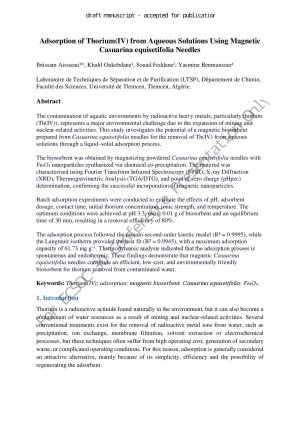
The contamination of aquatic environments by radioactive heavy metals, particularly thorium (Th(IV)), represents a major environmental challenge due to the expansion of mining and nuclear-related activities. This study investigates the potential of a magnetic biosorbent prepared from Casuarina equisetifolia needles for the removal of Th(IV) from aqueous solutions through a liquid–solid adsorption process.
The biosorbent was obtained by magnetizing powdered Casuarina equisetifolia needles with Fe₃O₄ nanoparticles synthesized via chemical co-precipitation. The material was characterized using Fourier Transform Infrared Spectroscopy (FTIR), X-ray Diffraction (XRD), Thermogravimetric Analysis (TGA/DTG), and point of zero charge (pHpzc) determination, confirming the successful incorporation of magnetic nanoparticles.
Batch adsorption experiments were conducted to evaluate the effects of pH, adsorbent dosage, contact time, initial thorium concentration, ionic strength, and temperature. The optimum conditions were achieved at pH 3.3, using 0.01 g of biosorbent and an equilibrium time of 30 min, resulting in a removal efficiency of 80%.
The adsorption process followed the pseudo-second-order kinetic model (R² = 0.9995), while the Langmuir isotherm provided the best fit (R² = 0.9945), with a maximum adsorption capacity of 61.73 mg g⁻¹. Thermodynamic analysis indicated that the adsorption process is spontaneous and endothermic. These findings demonstrate that magnetic Casuarina equisetifolia needles constitute an efficient, low-cost, and environmentally friendly biosorbent for thorium removal from contaminated water.
Keywords
Adsorption; Magnetic Biosorbent; Casuarina equisetifolia; Heavy Metals; Water Treatment
Manuscript
[Sciforum-207479] - [Manuscript PDF] - [Submission accepted].pdf
Lignin Valorisation: Synthesis of Compounds and Applications in Environmental Engineering
Optimization and Kinetic Investigation of the N-Chloroacetylation of Diphenylamine Using Chloroacetyl Chloride: Effects of Reaction Parameters, Mechanistic Insights, and Spectroscopic Characterization