Event submissions
Published
This submission belongs to the session Session 4. Physical Organic Chemistry of the event The 30th International Electronic Conference on Synthetic Organic Chemistry
Published date
02 Nov, 2026
Academic Editor
 Julio A. Seijas
Contribution&Funding
Conceptualization,
[Ruzimurod Jurayev]
Methodology,
[Ruzimurod Jurayev]
Software,
[Ruzimurod Jurayev]
Validation,
[Ruzimurod Jurayev]
Formal analysis,
[Ruzimurod Jurayev]
Investigation,
[Ruzimurod Jurayev]
Resources,
[Ruzimurod Jurayev]
Data curation,
[Ruzimurod Jurayev]
Writing - original draft,
[Ruzimurod Jurayev]
Writing - review,
[editing] ; [Ruzimurod Jurayev]
Visualization,
[Ruzimurod Jurayev]
Supervision,
[Ruzimurod Jurayev]
Project administration,
[Ruzimurod Jurayev]
Funding acquisition,
[Ruzimurod Jurayev]
Funding: --
Citation
Ruzimurod Jurayev, Optimization and Kinetic Investigation of the N-Chloroacetylation of Diphenylamine Using Chloroacetyl Chloride: Effects of Reaction Parameters, Mechanistic Insights, and Spectroscopic Characterization, in Proceedings of The 30th International Electronic Conference on Synthetic Organic Chemistry, 5 November–19 November 2026, MDPI: Basel, Switzerland
Share
Email
Facebook
Twitter
LinkedIn
Optimization and Kinetic Investigation of the N-Chloroacetylation of Diphenylamine Using Chloroacetyl Chloride: Effects of Reaction Parameters, Mechanistic Insights, and Spectroscopic Characterization

Ruzimurod Jurayev 1
1. Department of Industrial Engineering and Management, Karshi state technical university, Karshi, Uzbekistan
Abstract
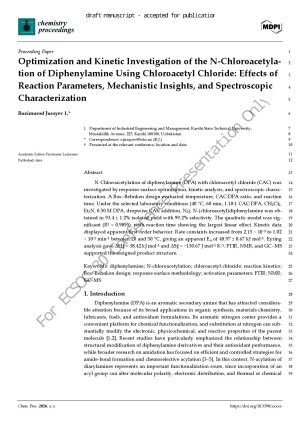
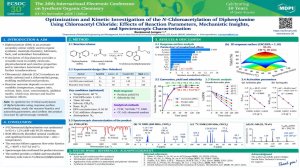
The N-acylation of aromatic amines represents a cornerstone reaction in organic synthesis, yet the chloroacetylation of diphenylamine remains mechanistically underexplored and lacks systematic kinetic characterization. This study presents a comprehensive investigation of the N-chloroacetylation of diphenylamine with chloroacetyl chloride, aiming to elucidate reaction kinetics, optimize process parameters, and establish a detailed mechanistic framework. A Box-Behnken design was employed to evaluate the combined effects of temperature (20-60 degC), molar ratio (1:1.0 to 1:1.5), and reaction time (30-120 min) on product yield. Under optimized conditions (40 degC, 60 min, 1:1.10 molar ratio, dichloromethane, triethylamine, 0.50 M, dropwise addition, nitrogen atmosphere), N-(chloroacetyl)diphenylamine was obtained in 93.4 +/- 1.2% isolated yield with >99% selectivity. Kinetic analysis revealed pseudo-first-order behavior with respect to diphenylamine, with rate constants of 2.15 x 10^-3, 3.82 x 10^-3, 6.47 x 10^-3, and 10.2 x 10^-3 min^-1 at 20, 30, 40, and 50 degC, respectively. The activation parameters were determined as Ea = 48.6 +/- 2.1 kJ mol^-1, dH‡ = 45.9 +/- 2.1 kJ mol^-1, dS‡ = -112.4 +/- 6.3 J mol^-1 K^-1, and dG‡ = 80.1 +/- 3.5 kJ mol^-1 at 298 K, consistent with an associative, bimolecular mechanism involving a tetrahedral intermediate. Comprehensive spectroscopic characterization (FTIR, 1H NMR, 13C NMR, GC-MS, elemental analysis) confirmed the structural integrity of the product. The reaction mechanism, involving nucleophilic attack of the nitrogen lone pair on the carbonyl carbon, formation of a tetrahedral intermediate, and chloride elimination, was supported by kinetic and computational evidence. This work fills a critical gap in the mechanistic understanding of N-chloroacetylation reactions and provides a robust, scalable protocol for the synthesis of N-(chloroacetyl)diphenylamine with potential applications in pharmaceutical and agrochemical industries.
Keywords
diphenylamine; chloroacetyl chloride; N-acylation; reaction kinetics; Box-Behnken design; activation parameters; mechanistic investigation; process optimization
Manuscript
[Sciforum-207968] - [Manuscript PDF] - [Submission accepted].pdf
Poster
[Sciforum-207968] - [Poster] - [Submission accepted].pdf
Adsorption of Thorium(IV) from Aqueous Solutions Using Magnetic Casuarina equisetifolia Needles
In Silico Physicochemical, Structural, and Immunoinformatic Characterization of MPV510 Fab Light Chain as a Potential Vaccine Candidate Against Human Metapneumovirus