Event submissions
Published
This submission belongs to the session Session 2. Chemistry of Bioorganics, Medicinal and Natural Products of the event The 30th International Electronic Conference on Synthetic Organic Chemistry
Published date
02 Nov, 2026
Academic Editor
 Julio A. Seijas
Citation
Avantika Agrawal, Umesh Verma, Achal Mishra, Designing, Synthesis and Characterisation of Novel Benzimidazole derivatives as Multi- Targeted anti-Alzheimer’s agent integrated with computational screening, in Proceedings of The 30th International Electronic Conference on Synthetic Organic Chemistry, 5 November–19 November 2026, MDPI: Basel, Switzerland
Share
Email
Facebook
Twitter
LinkedIn
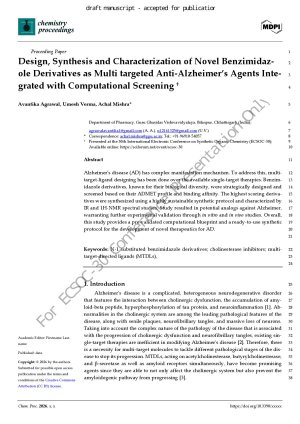
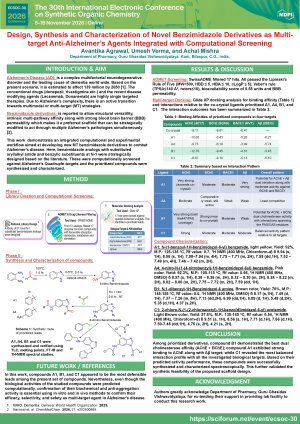
Designing, Synthesis and Characterisation of Novel Benzimidazole derivatives as Multi- Targeted anti-Alzheimer’s agent integrated with computational screening

Avantika Agrawal 1
Umesh Verma 1
Achal Mishra 1
1. Department of Pharmacy, Guru Ghasidas Vishwavidyalaya, Bilaspur, Chhattisgarh, India
Abstract
According to the cholinergic hypothesis, along with senile plaques, neurofibrillary tangles, and widespread neuronal loss, cholinergic abnormalities are the main features of Alzheimer's disease (AD). Multi-target-directed ligands (MTDLs) targeting acetylcholinesterase (AChE) and butyrylcholinesterase (BChE) and also amyloid-β receptors represent a promising therapeutic strategy for AD. Benzimidazole derivatives are known for their diverse biological activities, including anti-Alzheimer's properties. New benzimidazole derivatives with substituted aryl/alkyl amides and benzyl groups at the N-1 position were strategically designed based on the literature study. In total, a library of 52 molecules was generated, which was screened based on their ADMET profile and binding affinity for AChE, BChE, and amyloid-β proteins. To bridge theoretical design with experimental application, a highly sustainable synthetic protocol was performed for the highest-scoring derivatives. During synthesis, TLC analysis confirmed the successful completion of reactions. The characterisation was done based on their physicochemical properties i.e. melting points, and solubility etc. and also from their IR, 1H-NMR and 13C-NMR spectral studies. The results suggest that some benzimidazole-containing analogues have strong potential as anti-Alzheimer’s agents, warranting further experimental validation through in vitro and in vivo studies. In conclusion, the study provides a rigorous, pre-validated computational blueprint and a ready-to-use synthetic protocol to accelerate the development of novel therapeutics for Alzheimer's disease.
Keywords
N-1 substituted benzimidazole derivatives
Anti-Alzheimer agent
cholinesterase inhibitors
multi-target-directed ligands (MTDLs)
In-silico screening.
Manuscript
[Sciforum-201526] - [Manuscript PDF] - [Submission accepted].pdf
Poster
[Sciforum-201526] - [Poster] - [Submission accepted].pdf
Multicomponent reactions for covalent lysine labelling
Computational Assessment of Bioactive Compounds from Holoptelea integrifolia (Roxb). Planch against breast cancer using Molecular Docking and ADMET analysis