Event submissions
Published
This submission belongs to the session Session 2. Chemistry of Bioorganics, Medicinal and Natural Products of the event The 30th International Electronic Conference on Synthetic Organic Chemistry
Published date
02 Nov, 2026
Academic Editor
 Julio A. Seijas
Citation
Abanish Biswas, Ashok Kumar Pattnaik, Venkatesan Jayaprakash, Multi-Target QSAR Modelling against CYP1B1, CDK4 and Tubulin for Anticancer Drug Design, in Proceedings of The 30th International Electronic Conference on Synthetic Organic Chemistry, 5 November–19 November 2026, MDPI: Basel, Switzerland
Share
Email
Facebook
Twitter
LinkedIn
Multi-Target QSAR Modelling against CYP1B1, CDK4 and Tubulin for Anticancer Drug Design

Abanish Biswas 1
Ashok Kumar Pattnaik 1
Venkatesan Jayaprakash 1
1. Department of Pharmaceutical Sciences & Technology, Birla Institute of Technology, Mesra, Ranchi 835215, India
Abstract
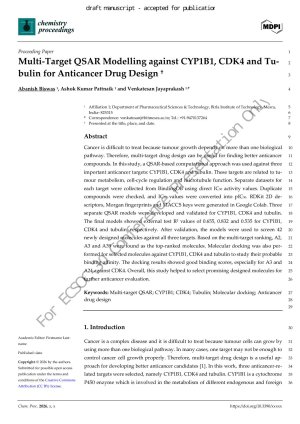
Cancer is a difficult disease to treat because tumour cells growth can depend on more than one biological pathway. Therefore, multi-target drug design may be useful for developing better anti-cancer candidates. In this study, a QSAR-based computational approach is proposed to identify potential compounds targeting CYP1B1, CDK4, and tubulin. These targets are related to tumour metabolism, cell-cycle regulation and microtubule functions. Separate datasets were obtained from BindingDB. Compounds having only direct target-based activity (IC50) were taken and duplicate compounds were checked. IC50 values were converted to pIC50. RDkit 2D descriptors, Morgan fingerprint descriptors, and pharmacophoric features were generated in Google Colab. Three separate QSAR models are developed and validated for each target. After proper validation, the three models will be used to predict activity of our designed molecule library against all three targets. In future, the best selected candidates will be furthur evaluated using structure-based methods. Molecular docking will be performed to study their probable binding mode inside the active sited of CYP1B1, CDK4, and tubulin. The most promising docked complexes wiil be evaluated for their stability by using molecular dynamics. And finally binding free energy analysis will be performed to estimate their probable binding affinity towrds the three target proteins. The developed models will be made publicly available on GitHub to support screening of new compounds by other researchers.
Keywords
Cancer
Multi-target
QSAR
RDkit
Fingerprint
Manuscript
[Sciforum-201765] - [Manuscript PDF] - [Submission accepted].pdf
Computational Assessment of Bioactive Compounds from Holoptelea integrifolia (Roxb). Planch against breast cancer using Molecular Docking and ADMET analysis