Event submissions
Published
This submission belongs to the session Session 2. Chemistry of Bioorganics, Medicinal and Natural Products of the event The 30th International Electronic Conference on Synthetic Organic Chemistry
Published date
03 Nov, 2026
Academic Editor
 Julio A. Seijas
Citation
Kehinde O. Amisu, Omobolanle E. Oladapo, Mona E. E. Eleiwa, Oladipupo A. Lawal, Victoria A. Dada, Rebamang A. Mosa, Foluso O. Osunsanmi, Andy R. Opoku, Solayide A. Adesida, Acetylcholinesterase, Antibacterial, Antiplatelet Aggregation, Membrane-Disruptive and Metabolic Enzyme Inhibitory Activities of Essential Oil from the buds of Syzygium aromaticum (L.) Merr. & L.M.Perry, in Proceedings of The 30th International Electronic Conference on Synthetic Organic Chemistry, 5 November–19 November 2026, MDPI: Basel, Switzerland
Share
Email
Facebook
Twitter
LinkedIn
Acetylcholinesterase, Antibacterial, Antiplatelet Aggregation, Membrane-Disruptive and Metabolic Enzyme Inhibitory Activities of Essential Oil from the buds of Syzygium aromaticum (L.) Merr. & L.M.Perry

Kehinde O. Amisu 1
Omobolanle E. Oladapo 1,2
Mona E. E. Eleiwa 3

Oladipupo A. Lawal 4,5
Victoria A. Dada 5
Rebamang A. Mosa 4,6

Foluso O. Osunsanmi 4
Andy R. Opoku 4
Solayide A. Adesida 7
1. Department of Microbiology, Lagos State University, PMB 0001 LASU Post Office, Ojo, Lagos, Nigeria
2. Department of Microbiology, Lagos State College of Nursing, Alimosho General Hospital Complex, LASU/Isheri Road, Igando Lagos State, Nigeria
3. Department of Biology, Ibn Sina National College for Medical Studies, P.O Box 31906, Al Mahjar, Al Mahjar Area, Jeddah 22421, Saudi Araba
4. Department of Biochemistry & Microbiology, University of Zululand, PMB X1001, KwaDlangezwa 3886, South Africa
5. Department of Chemistry, Lagos State University, PMB 0001 LASU Post Office, Ojo, Lagos, Nigeria
6. Department of Biochemistry, Genetics and Microbiology, University of Pretoria, PMB X20 Hatfield 0028, Pretoria, South Africa
7. Department of Microbiology, Faculty of Life Sciences, College of Medicine, University of Lagos, PMB.12003, Idi-Araba, Surulere, Lagos State, Nigeria
Abstract
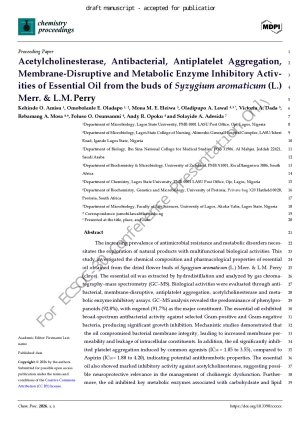
The increasing prevalence of antimicrobial resistance and metabolic disorders necessitates the exploration of natural products with multifunctional biological activities. This study investigated the chemical composition and pharmacological properties of essential oil obtained from the dried flower buds of Syzygium aromaticum (L.) Merr. & L.M. Perry (clove). The essential oil was extracted by hydrodistillation and analyzed by gas chromatography–mass spectrometry (GC–MS). Biological activities were evaluated through antibacterial, membrane-disruptive, antiplatelet aggregation, acetylcholinesterase and metabolic enzyme inhibitory assays. GC–MS analysis revealed the predominance of phenylpropanoids (92.8%), with eugenol (91.7%) as the major constituent. The essential oil exhibited broad-spectrum antibacterial activity against selected Gram-positive and Gram-negative bacteria, producing significant growth inhibition. Mechanistic studies demonstrated that the oil compromised bacterial membrane integrity, leading to increased membrane permeability and leakage of intracellular constituents. In addition, the oil significantly inhibited platelet aggregation induced by common agonists (IC50 = 1.05 to 3.55), compared to Aspirin (IC50 = 1.88 to 4.20), indicating potential antithrombotic properties. The essential oil also showed marked inhibitory activity against acetylcholinesterase, suggesting possible neuroprotective relevance in the management of cholinergic dysfunction. Furthermore, the oil inhibited key metabolic enzymes associated with carbohydrate and lipid metabolisms, supporting its potential role in the management of metabolic disorders. These findings highlight the multifunctional pharmacological potential of S. aromaticum flower bud essential oil as a natural source of antibacterial, antiplatelet, neuroactive, and metabolic enzyme inhibitory agents. Further in vivo studies and toxicological evaluations are warranted to validate its therapeutic applications and elucidate the underlying molecular mechanisms.
Keywords
Syzygium aromaticum
essential oil
eugenol
multifunctional pharmacological activity
Manuscript
[Sciforum-201805] - [Manuscript PDF] - [Submission accepted].pdf
Multi-Target QSAR Modelling against CYP1B1, CDK4 and Tubulin for Anticancer Drug Design
Pharmacophore Modeling of AHAS Inhibitors for Targeted Antifungal Discovery