Event submissions
Published
This submission belongs to the session Session 2. Chemistry of Bioorganics, Medicinal and Natural Products of the event The 30th International Electronic Conference on Synthetic Organic Chemistry
Published date
03 Nov, 2026
Academic Editor
 Julio A. Seijas
Citation
Fatima Abdurrazaq, Enayi Onaji, Abubakar Sadiq Yakubu, Asma'u Nasiru Hamza, A Computational Investigations of In_house Synthesized Chalcones and Pyrazolines Against Alpha-Glucosidase as Potential Antidiabetic Agents, in Proceedings of The 30th International Electronic Conference on Synthetic Organic Chemistry, 5 November–19 November 2026, MDPI: Basel, Switzerland
Share
Email
Facebook
Twitter
LinkedIn
A Computational Investigations of In_house Synthesized Chalcones and Pyrazolines Against Alpha-Glucosidase as Potential Antidiabetic Agents

Fatima Abdurrazaq 1
Enayi Onaji 1
Abubakar Sadiq Yakubu 1
Asma'u Nasiru Hamza 1
1. Department of Pharmaceutical and Medicinal Chemistry, Faculty of Pharmaceutical Sciences, Ahmadu Bello University, Zaria, Nigeria
Abstract
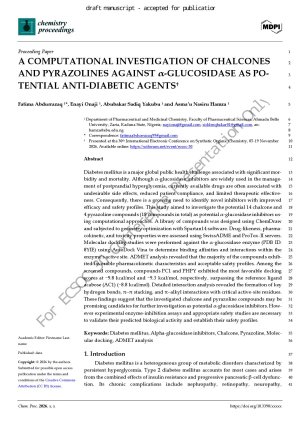
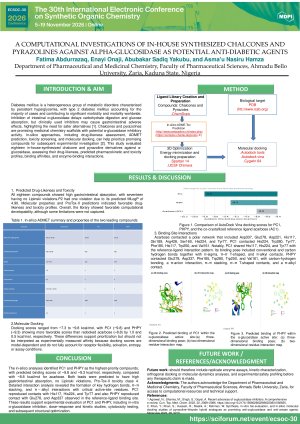
Background/Context: Diabetes mellitus is a major global public health challenge associated with significant morbidity and mortality. Although α-glucosidase inhibitors are widely used in the management of postprandial hyperglycemia, currently available drugs are often associated with undesirable side effects, reduced patient compliance, and limited therapeutic effectiveness. Consequently, there is a growing need to identify novel inhibitors with improved efficacy and safety profiles.
Objective: This study aimed to evaluate the anti-diabetic potential of 18 in-house synthesized chalcone and pyrazoline as α-glucosidase inhibitors through comprehensive in-silico analyses.
Methods: A library of 18 compounds was designed using ChemDraw and subjected to geometry optimization with Spartan14 software. Drug-likeness, pharmacokinetic, and toxicity properties were assessed using SwissADME and ProTox-II servers. Molecular docking studies were performed against the α-glucosidase enzyme (PDB ID: 8YIE) using AutoDock Vina to determine binding affinities and interactions within the enzyme's active site.
Results: ADMET analysis revealed that the majority of the compounds exhibited favorable pharmacokinetic characteristics and acceptable safety profiles. Among the screened compounds, compounds PC1 and PHPY demonstrated the highest binding affinities of −9.8 kcal/mol and −9.3 kcal/mol, respectively, surpassing the co-crystallized ligand AC1 (−8.8 kcal/mol). Detailed interaction analysis revealed the formation of key hydrogen bonds, π–π stacking, and π–alkyl interactions with critical active-site residues.
Conclusion/Impact: The findings suggest that chalcone and pyrazoline possess promising α-glucosidase inhibitory potential and may serve as valuable lead compounds for the development of safer and more effective anti-diabetic therapies.
Keywords
Diabetes mellitus
Alpha-glucosidase inhibitors
Chalcone
Pyrazoline
Molecular docking
ADMET analysis
Manuscript
[Sciforum-201927] - [Manuscript PDF] - [Submission accepted].pdf
Poster
[Sciforum-201927] - [Poster] - [Submission accepted].pdf
Repurposing FDA-Approved Drugs as Novel Inhibitors of the MbtB condensation/cyclization (Cy) Domain in Mycobacterium tuberculosis
Machine Learning Assisted QSAR Modelling of Human-MAO-B Inhibitors