Event submissions
Published
This submission belongs to the session Session 2. Chemistry of Bioorganics, Medicinal and Natural Products of the event The 30th International Electronic Conference on Synthetic Organic Chemistry
Published date
03 Nov, 2026
Academic Editor
 Julio A. Seijas
Citation
Rupsa Mondal, Abanish Biswas, Ashok Kumar Pattnaik, Venkatesan Jayaprakash, Machine Learning Assisted QSAR Modelling of Human-MAO-B Inhibitors, in Proceedings of The 30th International Electronic Conference on Synthetic Organic Chemistry, 5 November–19 November 2026, MDPI: Basel, Switzerland
Share
Email
Facebook
Twitter
LinkedIn
Machine Learning Assisted QSAR Modelling of Human-MAO-B Inhibitors

Rupsa Mondal 1
Abanish Biswas 1
Ashok Kumar Pattnaik 1
Venkatesan Jayaprakash 1
1. Department of Pharmaceutical Sciences & Technology, Birla Institute of Technology, Mesra, India- 825315
Abstract
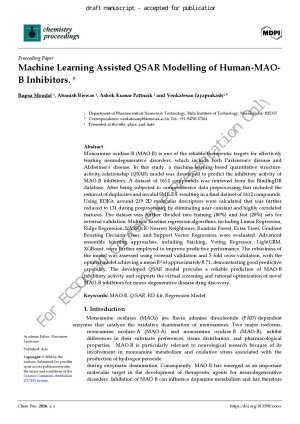
Monoamine oxidase-B (MAO-B) is one of the valid therapeutic targets for the effective treatment of neurodegenerative disorders, which include both Parkinson's disease and Alzheimer's disease. In this study, a machine-learning-based quantitative structure–activity relationship (QSAR) model was developed to predict the inhibitory activity of MAO-B inhibitors. A dataset of 1614 compounds was retrieved from the BindingDB database. After being subjected to comprehensive data preprocessing that included the removal of duplicates and invalid SMILES, resulting in a final dataset of 1612 compounds. Using RDKit, around 219 2D molecular descriptors were calculated that was further reduced to 131 during preprocessing by eliminating near-constant and highly correlated features. The dataset was further divided into training (80%) and test (20%) sets for external validation. Multiple baseline regression algorithms, including Linear Regression, Ridge Regression, LASSO, K-Nearest Neighbours, Random Forest, Extra Trees, Gradient Boosting Decision Trees, and Support Vector Regression, were evaluated. Advanced ensemble learning approaches, including Stacking, Voting Regressor, LightGBM, XGBoost, and CatBoost, were further employed to improve predictive performance. The robustness of the model was assessed using external validation and 5-fold cross-validation, with the optimal model achieving a mean R² of approximately 0.71, demonstrating good predictive capability. The developed QSAR model provides a reliable prediction of MAO-B inhibitory activity and supports the virtual screening and rational optimization of novel MAO-B inhibitors for neurodegenerative disease drug discovery
Keywords
MAO-B
QSAR
BindingDB
Regression
RDkit
Manuscript
[Sciforum-201973] - [Manuscript PDF] - [Submission accepted].pdf
A Computational Investigations of In_house Synthesized Chalcones and Pyrazolines Against Alpha-Glucosidase as Potential Antidiabetic Agents
Chemometric Classification of Vegetable Oils by ¹³C NMR Spectroscopy and Principal Component Analysis