Event submissions
Published
This submission belongs to the session Session 2. Chemistry of Bioorganics, Medicinal and Natural Products of the event The 30th International Electronic Conference on Synthetic Organic Chemistry
Published date
03 Nov, 2026
Academic Editor
 Julio A. Seijas
Citation
CHERIGUI Samir, Ferial CHELLALI, Ilyas Chikhi, Fayçal Dergal, Chemometric Classification of Vegetable Oils by ¹³C NMR Spectroscopy and Principal Component Analysis, in Proceedings of The 30th International Electronic Conference on Synthetic Organic Chemistry, 5 November–19 November 2026, MDPI: Basel, Switzerland
Share
Email
Facebook
Twitter
LinkedIn
Chemometric Classification of Vegetable Oils by ¹³C NMR Spectroscopy and Principal Component Analysis

CHERIGUI Samir 1
Ferial CHELLALI 2
Ilyas Chikhi 2
Fayçal Dergal 3
1. Department of Chemistry, Faculty of Exact Sciences, University of Béjaïa, Béjaïa 06000, Algeria
2. Laboratory of Catalysis and Synthesis in Organic Chemistry (LCSCO) - University of Tlemcen, Chemistry, Tlemcen, Algeria
3. Scientific and Technical Research Center for Physico-Chemical Analysis (CRAPC), Bou-Ismail, Algeria
Abstract
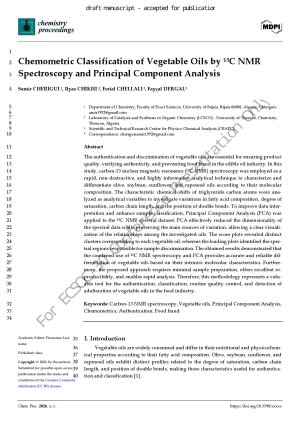
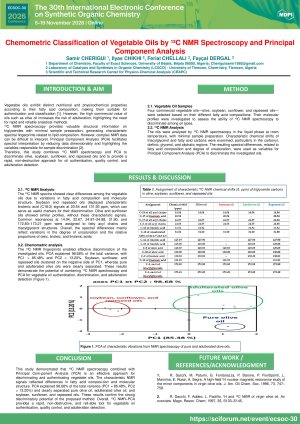
The authentication and discrimination of vegetable oils are essential for ensuring product quality, verifying authenticity, and preventing food fraud in the edible oil industry. In this study, carbon-13 nuclear magnetic resonance (¹³C NMR) spectroscopy was employed as a rapid, non-destructive, and highly informative analytical technique to characterize and differentiate olive, soybean, sunflower, and rapeseed oils according to their molecular composition. The characteristic chemical shifts of triglyceride carbon atoms were analyzed as analytical variables to investigate variations in fatty acid composition, degree of saturation, carbon chain length, and the position of double bonds. To improve data interpretation and enhance sample classification, Principal Component Analysis (PCA) was applied to the ¹³C NMR spectral dataset. PCA effectively reduced the dimensionality of the spectral data while preserving the main sources of variation, allowing a clear visualization of the relationships among the investigated oils. The score plots revealed distinct clusters corresponding to each vegetable oil, whereas the loading plots identified the spectral regions responsible for sample discrimination. The obtained results demonstrated that the combined use of ¹³C NMR spectroscopy and PCA provides accurate and reliable differentiation of vegetable oils based on their intrinsic molecular characteristics. Furthermore, the proposed approach requires minimal sample preparation, offers excellent reproducibility, and enables rapid analysis. Therefore, this methodology represents a valuable tool for the authentication, classification, routine quality control, and detection of adulteration of vegetable oils in the food industry.
Keywords
Carbon-13 NMR spectroscopy
Vegetable oils
Principal Component Analysis
Chemometrics
Authentication: Food fraud
Manuscript
[Sciforum-202017] - [Manuscript PDF] - [Submission accepted].pdf
Poster
[Sciforum-202017] - [Poster] - [Submission accepted].pdf
Machine Learning Assisted QSAR Modelling of Human-MAO-B Inhibitors
In Silico Design and Atom-Based 3D-QSAR Studies of Novel Flavonoid Derivatives as Potent alpha-Glucosidase Inhibitors