Event submissions
Published
This submission belongs to the session Session 2. Chemistry of Bioorganics, Medicinal and Natural Products of the event The 30th International Electronic Conference on Synthetic Organic Chemistry
Published date
03 Nov, 2026
Academic Editor
 Julio A. Seijas
Citation
Abderahmane Belafriekh, Aicha Laoud, In Silico Design and Atom-Based 3D-QSAR Studies of Novel Flavonoid Derivatives as Potent alpha-Glucosidase Inhibitors, in Proceedings of The 30th International Electronic Conference on Synthetic Organic Chemistry, 5 November–19 November 2026, MDPI: Basel, Switzerland
Share
Email
Facebook
Twitter
LinkedIn
In Silico Design and Atom-Based 3D-QSAR Studies of Novel Flavonoid Derivatives as Potent alpha-Glucosidase Inhibitors

Abderahmane Belafriekh 1
Aicha Laoud 2
1. Laboratory of LCPMM, Organic Chemistry Department, Faculty of Sciences, University of Blida 1, Blida, Algeria
2. Department of Chemical Engineering, Faculty of Chemical Engineering, University of Salah Boubnider Constantine 3, Constantine 25000, Algeria.
Abstract
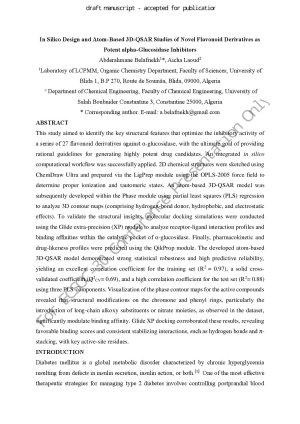
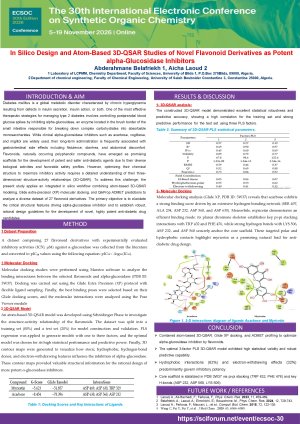
This study aimed to identify the key structural features that optimize the inhibitory activity of a series of 28 flavonoid derivatives against α-glucosidase, with the ultimate goal of providing rational guidelines for the generation of highly potent drug candidates. An integrated in silico computational workflow was successfully applied. 2D chemical structures were sketched using ChemDraw Ultra and prepared via the LigPrep module using the OPLS-2005 force field to determine proper ionization and tautomeric states. An atom-based 3D-QSAR model was subsequently developed within the Phase module using partial least squares (PLS) regression to analyze 3D contour maps (comprising hydrogen-bond donor, hydrophobic, and electrostatic effects). To validate the structural insights, molecular docking simulations were conducted using the Glide extra-precision (XP) module to analyze receptor-ligand interaction profiles and binding affinities within the catalytic pocket of -glucosidase. Finally, pharmacokinetic and drug-likeness profiles were predicted using the QikProp module. The developed atom-based 3D-QSAR model demonstrated strong statistical robustness and high predictive reliability, yielding an excellent correlation coefficient for the training set (R2= 0.97), a solid cross-validated coefficient (Q2CV= 0.69), and a high correlation coefficient for the test set (R2= 0.88) using three PLS-components. Visualization of the phase contour maps for the active compounds revealed that structural modifications on the chromone and phenyl rings, particularly the introduction of long-chain alkoxy substituents or nitrate moieties, as observed in the dataset, significantly modulate binding affinity. Glide XP docking corroborated these results, revealing favorable binding scores and consistent stabilizing interactions, such as hydrogen bonds and -stacking, with key active-site residues.
Keywords
Flavonoids
α-Glucosidase
Glide XP Docking
Atom-based 3D-QSAR
Phase contours
Manuscript
[Sciforum-202027] - [Manuscript PDF] - [Submission accepted].pdf
Poster
Poster-Abderahmane Belafriekh.pdf
Chemometric Classification of Vegetable Oils by ¹³C NMR Spectroscopy and Principal Component Analysis
Molecular characteristics of a β-glucan-rich polysaccharide isolated from Lentinula edodes and metabolism outcomes in simulated human gut microbiota