Event submissions
Published
This submission belongs to the session Session 2. Chemistry of Bioorganics, Medicinal and Natural Products of the event The 30th International Electronic Conference on Synthetic Organic Chemistry
Published date
03 Nov, 2026
Academic Editor
 Julio A. Seijas
Citation
Abdalrahem Shtawa, ENAS BSHENA, Magdi Hassn B. Mussa, Sarra Takita, Design a Hybrid Organic–Pharmaceutical Matrix System for Controlled Drug Delivery: Case Study of Linking Tuneable Diclofenac Sodium Release via Hydrogenated Cottonseed Oil, in Proceedings of The 30th International Electronic Conference on Synthetic Organic Chemistry, 5 November–19 November 2026, MDPI: Basel, Switzerland
Share
Email
Facebook
Twitter
LinkedIn
Design a Hybrid Organic–Pharmaceutical Matrix System for Controlled Drug Delivery: Case Study of Linking Tuneable Diclofenac Sodium Release via Hydrogenated Cottonseed Oil

Abdalrahem Shtawa 1,2
ENAS BSHENA 3
Magdi Hassn B. Mussa 1,2
Sarra Takita 2,4
1. North Africa International Centre for Research on Serums, Vaccines and Genetic Diseases, Libyan Authority for Scientific Research, Zawia P.O. Box 80045, Libya
2. Materials and Engineering Research Institute MERI, Sheffield Hallam University, Howard Street, Sheffield S1 1WB, UK
3. Medical Research Centre Zawia, Libyan Authority for Scientific Research, Zawia P.O. Box 80045, Libya
4. Biomolecular Sciences Research Centre (BMRC), Sheffield Hallam University, Howard Street, Sheffield S1 1WB, UK
Abstract
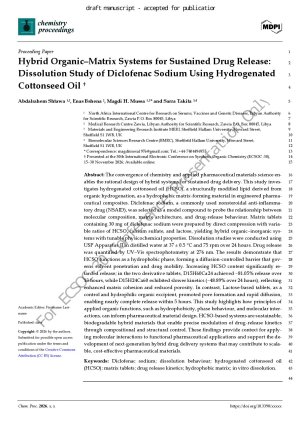
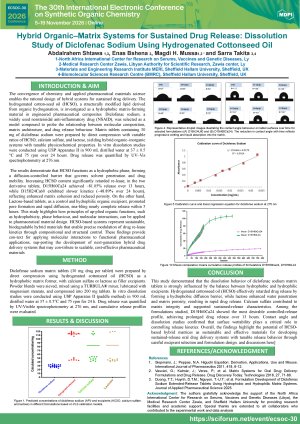
The convergence of chemistry and applied pharmaceutical materials science enables the rational design of hybrid systems for sustained drug delivery. Hydrogenated cottonseed oil (HCSO), a lipid modified via organic hydrogenation, was investigated as a hydrophobic matrix-forming material within engineered pharmaceutical composites. Diclofenac sodium, a widely used nonsteroidal anti-inflammatory drug (NSAID), served as a model compound to explore the relationship between composition, matrix architecture, and drug release behaviour. Matrix tablets containing 30 mg diclofenac sodium were prepared by direct compression using varying ratios of HCSO, calcium sulphate, and lactose as a control matrix, generating hybrid organic–inorganic systems with tunable physicochemical properties. In vitro dissolution studies were performed using USP Apparatus II in 900 mL distilled water at 37 ± 0.5°C and 75 rpm over 24 hours, with drug release quantified by UV–Vis spectrophotometry at 276 nm.
Results demonstrate that HCSO acts as a hydrophobic phase, forming a diffusion-controlled barrier that modulates solvent penetration and drug mobility. Increasing HCSO content significantly retarded drug release: formulation D15H60Ca24 achieved ~81.05% release over 13 hours, while D15H24Ca60 showed slower kinetics (~48.89% over 24 hours), indicating enhanced matrix cohesion and reduced porosity. In contrast, lactose-based formulations promoted pore formation and rapid diffusion, enabling near-complete release within 5 hours. This study highlights how applied organic chemistry principles, including hydrophobicity, phase behaviour, and molecular interactions, can guide the design of pharmaceutical materials. HCSO-based systems represent sustainable, biodegradable platforms capable of precise modulation of drug release kinetics, supporting the development of scalable, cost-effective hybrid drug delivery systems.
Keywords
Diclofenac sodium
sustained-release
dissolution behaviour
hydrogenated cottonseed oil (HCSO)
matrix tablets
drug release kinetics
hydrophobic
in vitro dissolution
Manuscript
[Sciforum-193097] - [Manuscript PDF] - [Submission accepted].pdf
Poster
[Sciforum-193097] - [Poster] - [Submission accepted].pdf
Synthesis of new hybrid heterocycles based on transamination reactions of 3-[(dimethylamino)methylene]chromane-2,4-dione
Extraction of Pectin from Orange Peel Waste and Its Ionic Cross-Linking with Copper and Zinc Ions: Structural Characterization and Antimicrobial Evaluation