Event submissions
Published
This submission belongs to the session Session 4. Physical Organic Chemistry of the event The 30th International Electronic Conference on Synthetic Organic Chemistry
Published date
03 Nov, 2026
Academic Editor
 Julio A. Seijas
Contribution&Funding
Conceptualization,
[Sergio Rosales] ; [Miguel Fernandez] ; [Camila Ballesteros] ; [Ainara Alexandra Leizaola]
Methodology,
[Camila Ballesteros] ; [Miguel Fernandez] ; [Ainara Alexandra Leizaola]
Software,
[Camila Ballesteros] ; [Ainara Alexandra Leizaola]
Validation,
[Camila Ballesteros] ; [Miguel Fernandez] ; [Ainara Alexandra Leizaola]
Formal analysis,
[Camila Ballesteros] ; [Ainara Alexandra Leizaola]
Investigation,
[Ainara Alexandra Leizaola] ; [Camila Ballesteros]
Resources,
[Miguel Fernandez] ; [Sergio Rosales]
Data curation,
[Ainara Alexandra Leizaola] ; [Camila Ballesteros]
Writing - original draft,
[Ainara Alexandra Leizaola] ; [Camila Ballesteros]
Writing - review,
[editing] ; [Ainara Alexandra Leizaola] ; [Camila Ballesteros] ; [Miguel Fernandez] ; [Sergio Rosales]
Visualization,
[Camila Ballesteros] ; [Ainara Alexandra Leizaola]
Supervision,
[Miguel Fernandez] ; [Sergio Rosales]
Funding: --
Citation
Camila Ballesteros, Ainara Alexandra Leizaola, Miguel Fernandez, Sergio Rosales, Study of interactions of Ni/Zn-thiazole complexes using the DFT method, in Proceedings of The 30th International Electronic Conference on Synthetic Organic Chemistry, 5 November–19 November 2026, MDPI: Basel, Switzerland
Share
Email
Facebook
Twitter
LinkedIn
Study of interactions of Ni/Zn-thiazole complexes using the DFT method

Camila Ballesteros 1
Ainara Alexandra Leizaola 1
Miguel Fernandez 2
Sergio Rosales 3
1. School of Chemical Engineering, Universidad Metropolitana - UNIMET, Caracas, 1073, Venezuela
2. Computational Chemistry Laboratory, Venezuelan Institute for Scientific Research (IVIC), “Dr. Gabriel Chuchani” Chemistry Center, Caracas, 1020-A, Venezuela
3. Energy and Automation, Universidad Metropolitana - UNIMET, Caracas, 1073, Venezuela
Abstract
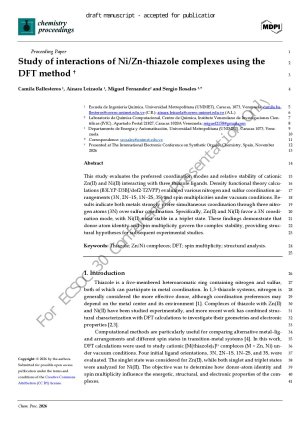
This study aimed to determine the preferred coordination modes of Zn(II) and Ni(II) interacting with three thiazole ligands and evaluate how the donor atom directly coordinated to the metal affects relative stability and electronic structure of the complexes. Density functional theory calculations were performed using the B3LYP-D3BJ exchange-correlation functional and the def2-TZVPP basis set for cationic Zn(II) and Ni(II) complexes under vacuum conditions. Several coordination arrangements involving nitrogen and sulfur atoms were considered, including 3N, 2N-1S, 1N-2S, and 3S arrangements. Geometries were optimized, and structures were characterized through total and relative energies, metal-donor bond orders, atomic charges, and harmonic vibrational frequencies. For nickel and zinc complexes, different spin multiplicities were evaluated to identify the lowest-energy state. The zinc complexes were preferentially coordinated through nitrogen atoms of three thiazole ligands, corresponding to a 3N arrangement. This structure was lower in energy than configurations involving sulfur coordination. Similarly, nickel preferentially coordinated through nitrogen atoms of three thiazole ligands. The 3N nickel complex in the triplet state was the most stable structure. Results indicate that both metals share a strong preference for simultaneous coordination through three nitrogen atoms over sulfur coordination. Configurations with a larger sulfur contribution were generally less stable. Both Zn(II) and Ni(II) favor a 3N coordination mode, with Ni(II) associated with a triplet state. These findings indicate that donor-atom identity and spin multiplicity govern the relative stability of the complexes and provide structural hypotheses for subsequent experimental studies.
Keywords
Thiazole
Zn/Ni complexes
DFT
Ligand-metal interaction
spin multiplicity
Manuscript
[Sciforum-208014] - [Manuscript PDF] - [Submission accepted].pdf
Copper(II) Complexes of Hydrazones: Synthesis, Characterization and Activity Against Phytophthora infestans
Synthesis of BODIPY–amino acids: A strategy for bioconjugate synthesis