Event submissions
Published
 10.3390/chemproc2026022063 (registering DOI)
This submission belongs to the session Session 2. Chemistry of Bioorganics, Medicinal and Natural Products of the event The 30th International Electronic Conference on Synthetic Organic Chemistry
Published date
03 Nov, 2026
Academic Editor
 Julio A. Seijas
Citation
Rocío Rojas-Durán, Miguel A. Vázquez, José G. Becerra González, Eduardo Peña Cabrera, Synthesis of BODIPY–amino acids: A strategy for bioconjugate synthesis, in Proceedings of The 30th International Electronic Conference on Synthetic Organic Chemistry, 5 November–19 November 2026, MDPI: Basel, Switzerland, doi: 10.3390/chemproc2026022063
Share
Email
Facebook
Twitter
LinkedIn
Synthesis of BODIPY–amino acids: A strategy for bioconjugate synthesis

Rocío Rojas-Durán 1
Miguel A. Vázquez 1
José G. Becerra González 1
Eduardo Peña Cabrera 1
1. Departamento de Química, Universidad de Guanajuato, Noria Alta S/N, Guanajuato 36050, Mexico
Abstract
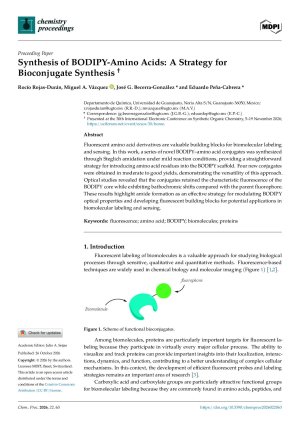
The development of fluorescent amino acid derivatives has significantly expanded the scope of bioconjugation strategies for the labeling of peptides and proteins. Among the available fluorophores, BODIPY dyes have attracted considerable attention owing to their excellent photophysical properties, including high molar absorptivity, high fluorescence quantum yields, and remarkable photostability, making them attractive alternatives to conventional fluorescent probes. Moreover, BODIPY-based amino acid derivatives represent versatile building blocks for the preparation of fluorescent bioconjugates with potential applications in biomolecular labeling, sensing, and imaging.
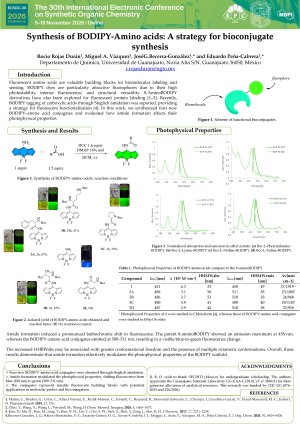
In this work, a series of novel BODIPY–amino acid derivatives was synthesized through Steglich esterification under mild reaction conditions. The synthetic strategy afforded the target compounds in moderate to good yields while preserving the integrity of the BODIPY core. The obtained derivatives were fully characterized by 1H and 13C NMR spectroscopy, as well as high-resolution mass spectrometry, confirming their chemical structures.
Photophysical characterization revealed that the synthesized compounds retain the characteristic optical features of the BODIPY fluorophore while exhibiting a bathochromic shift relative to the parent BODIPY scaffold, indicating that amide bond formation significantly influences the electronic structure of the fluorophore.
These findings demonstrate that the proposed synthetic approach provides efficient access to fluorescent BODIPY–amino acid derivatives and highlight their potential as versatile building blocks for the development of bioconjugates with prospective applications in protein labeling and biomolecular sensing.
Keywords
bioconjugate
fluorophores
BODIPY
peptides
proteins
Manuscript
Sciforum-202879.pdf
Poster
[Sciforum-202879] - [Poster] - [Submission accepted].pdf
Study of interactions of Ni/Zn-thiazole complexes using the DFT method
Synthesis and structural analysis of open-chain zwitterionic Stenhouse salts derived from furfural, morpholine, and tetracarbonitrile derivatives